
Gutters do more work than most homeowners realize
Across the Branson and Springfield area, gutters are the quiet system that keeps water away from your foundation, siding, and landscaping. When they're sized right and installed clean, you forget they exist. When they're not, you find out during the next hard rain, watching water sheet off the roof edge instead of running through the downspout where it belongs.
Because gutters look simple from the ground, a lot of homeowners assume pricing should be simple too. It isn't, and understanding why helps you compare quotes on more than just the bottom line number. The factors below are the ones that actually move a gutter estimate up or down, whether you're in Merriam Woods, Ozark, or anywhere else in the region.
Why gutter pricing varies so much house to house
Gutter cost isn't one number, it's a stack of smaller decisions that add up differently on every roofline. The length of gutter needed, the number of corners and downspouts, and the condition of the fascia boards underneath all factor in before material or labor even enters the picture.
Roofline length and complexity
A simple rectangular roof with two long, straight runs costs less to gutter than a home with multiple gables, dormers, or roof valleys that each need their own drainage path. More corners mean more seams, more end caps, and more places water can find a way to leak if the install isn't tight.
Homes with steep pitches or multiple stories also add complexity, since taller ladders and more careful staging slow the work down. None of this is unusual for the region's older two-story homes, but it does mean two houses of similar square footage can price very differently based on roof shape alone.
Fascia and existing damage
If the fascia board behind your existing gutters has rotted from years of overflow or a bad seal, that board needs to be repaired or replaced before new gutters go up. Skipping this step means the new system is fastened to soft wood, which shortens its life no matter how good the gutter itself is.
Fascia repair adds labor and material that wasn't part of the original gutter estimate, which is why a contractor should always check it before quoting rather than after the ladders are already up. It's one of the more common reasons a final invoice differs from the first phone estimate.
| Factor | Pushes cost down | Pushes cost up |
|---|---|---|
| Roofline shape | Simple rectangle, few corners | Multiple gables and valleys |
| Fascia condition | Solid wood, no rot | Replacement boards needed |
| Guard system | No guards | Gutter guards added |
| Downspout count | Existing count is sufficient | Additional downspouts needed |
The gutter system itself, piece by piece
A gutter system is more than the trough you see from the driveway. It includes hangers spaced to hold up under wet leaves and ice, end caps sealed against leaks, elbows that redirect water at corners, and downspouts sized to carry the volume your roof actually sheds. Gutters work as a full system, and skimping on any one piece shows up as a problem somewhere else.
Downspout placement matters as much as the trough itself. Water that has nowhere efficient to exit backs up in the gutter, overflows at the low point, and erodes soil or damages siding right where it lands. A system sized for your specific roof, not a generic average, is what keeps that from happening season after season.
Step-by-step: how a gutter estimate gets built
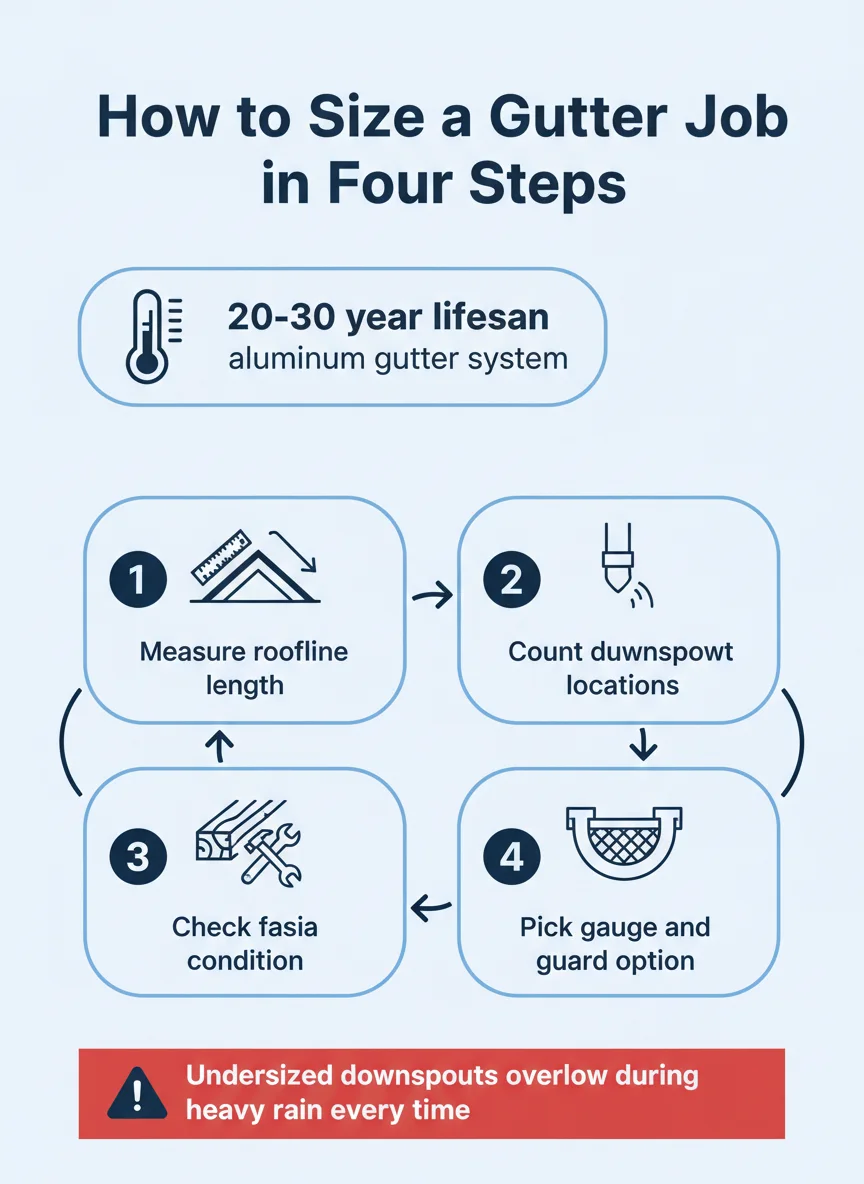
Most reputable gutter estimates follow a similar sequence, even if the final number looks different from house to house. Here's what that process generally covers.
- Measure the roofline: The full linear footage of gutter needed gets measured, including every corner and offset section.
- Inspect the fascia: Existing boards get checked for rot or soft spots that would need repair before install.
- Count downspouts: Current downspout locations are reviewed against the volume of water each roof section sheds.
- Choose material and gauge: Aluminum thickness and finish options are selected based on budget and expected wear.
- Decide on guards: Guard systems are added if tree cover or maintenance access make ongoing cleanup a concern.
- Confirm slope: Gutters are pitched slightly toward downspouts so water doesn't pool along the run.
What overflow and sagging actually tell you
If your current gutters are overflowing during rain or sagging away from the fascia, that's useful diagnostic information before you even call for a quote. Overflow at specific points usually means undersized downspouts or a blockage, not a system-wide failure.
Overflow at corners or seams
Water spilling over at a corner or seam often means that section wasn't sealed tightly, or debris has built up right at the joint. This is a targeted repair, not a reason to replace the whole system, and it's worth pointing out to whoever comes to look at it.
Persistent overflow at the same spot across multiple rain events, rather than just during the heaviest storms, is the stronger signal that something structural needs attention, whether that's a downspout swap or a fascia repair. For more on what overflow and fascia rot usually mean, see Gutters overflowing or fascia rot: what it usually means.
Sagging along a straight run
Gutters that sag or pull away along a long straight section usually point to failing hangers or fascia that's lost its holding strength. This is more involved than a corner leak, since it often means the whole run needs to come down and go back up with new fasteners.
Sagging is also a sign the system may be older than the fascia can support, especially if the home has never had gutters replaced. In that case, a full system replacement usually makes more sense than patching individual hangers.
What a homeowner can handle versus what needs a pro
Cleaning debris out of gutters a few times a year is a reasonable DIY task for anyone comfortable on a ladder, and it's the single best thing you can do to extend the life of an existing system. Clearing leaves and buildup before they compact into a clog prevents most overflow issues before they start.
Fascia repair, downspout resizing, and full system installation are a different category of work. These jobs involve fastening into structural wood, matching pitch across long runs, and sealing seams so they hold up to years of freeze-thaw cycles, which is why they're best left to a licensed crew with the right equipment.
If you're not sure which category your situation falls into, a quick look from a professional costs you nothing and tells you whether you're looking at a cleaning job or a real repair. That's a much cheaper phone call than guessing wrong and dealing with fascia damage a year later.
Getting a gutter quote that actually matches your home
The best way to get an accurate gutter number is to have someone walk your actual roofline rather than quote off square footage alone. Corners, downspout count, and fascia condition all matter more than the size of the house itself, and a good estimate accounts for all three before it gets written down.
If your gutters are overflowing, sagging, or just older than you can remember, it's worth getting a second set of eyes on them before the next heavy rain. Full Life Roofing Construction can take a look and walk you through what your specific system actually needs.
Frequently asked questions
Why do gutter quotes vary so much between contractors?
Quotes vary because contractors price the linear footage, the number of downspouts, and the fascia condition differently, and some include guards or extra hangers while others don't. Two houses of the same size can get very different numbers if one has rotted fascia boards that need replacing first.
Does the material change the price a lot?
Yes, material is one of the biggest swing factors, since standard aluminum runs cheaper than heavier-gauge or copper systems. The gauge of the aluminum itself also matters, with thicker metal costing more but holding up better to ladders, debris, and ice buildup over the years.
Do gutter guards add much to the cost?
Gutter guards do add to the upfront number, but they cut down on cleaning trips over the life of the system. Whether they're worth it depends on how many trees overhang your roofline in Branson, Ozark, or wherever your home sits.
Is it cheaper to replace gutters at the same time as a roof?
It's often more efficient to handle both together, since the crew is already on site with ladders and equipment set up. Doing them separately isn't necessarily more expensive, but you avoid a second mobilization when you bundle the work.
Why would a contractor recommend more downspouts than I currently have?
More downspouts usually get recommended when the existing layout can't keep up with the volume of water coming off a given roof section. Adding one costs more upfront but prevents overflow that can damage fascia or landscaping during heavy storms.