
Why Roof Lifespan Looks Different in Missouri
Ask ten roofers how long a roof lasts and you'll get ten different answers, because the honest answer always depends on material, installation quality, and climate. In the Branson and Springfield area, that climate swings hard. Summers bring long stretches of heat and UV exposure, winters bring ice and freeze-thaw cycles, and spring storms bring wind that tests every nail and seam. All three of those forces chip away at a roof's expected lifespan at different speeds depending on what the roof is made of.
That's why a lifespan number by itself isn't that useful without context. A 25-year shingle roof installed with poor attic ventilation might show wear by year 15. A metal roof rated for 50 years can underperform that if flashing details were rushed. Homeowners in towns like Ozark, Hollister, and Springfield are usually better served knowing the realistic range for their material and the specific things in this region that shorten it, rather than a single marketing number.
Why Materials Wear Out at Different Rates
Every roofing material is built from different components layered for weather resistance, and those layers degrade differently under sun, moisture, and temperature swings. Asphalt shingles rely on a granule coating over an asphalt-saturated mat, metal panels rely on a painted or coated steel or aluminum surface, and flat membranes rely on a continuous waterproof sheet. Once you understand what actually breaks down on each one, the lifespan ranges make a lot more sense.
UV, Heat, and Thermal Cycling
Missouri summers put a lot of UV and heat stress on a roof surface. On asphalt shingles, UV exposure slowly bakes out the oils in the asphalt mat, which is what eventually causes curling, cracking, and granule loss. Metal roofing resists UV damage far better because the surface is a painted metal substrate rather than an oil-based asphalt compound, which is part of why metal lifespans run so much longer.
Thermal cycling, the daily expansion and contraction as temperatures swing from a hot afternoon to a cool evening, stresses every fastener and seam on a roof. Over enough years this loosens nails, opens small gaps in flashing, and fatigues metal panel seams if they weren't detailed correctly at install. It's a slow process, but it's constant, and it's one reason install quality matters as much as material choice.
Wind, Ice, and Moisture
Winter in the Ozarks brings freeze-thaw cycles that can work water into tiny cracks, where it expands as ice and widens the damage. This is especially hard on aging shingles that have already lost some flexibility from UV exposure, and it's a common reason a roof that looked fine in October shows new problems by March.
Spring and summer storms add wind stress on top of all of that. Shingles with weakened adhesive seal strips are more likely to lift or tear in high wind, and metal panels with worn fasteners can work loose over time. None of these forces alone destroys a roof quickly, but stacked year after year they're what separates a roof that hits the top of its lifespan range from one that falls short.
| Material | Typical Lifespan Range | What Shortens It in Missouri |
|---|---|---|
| Three-tab asphalt shingles | 15-20 years | UV breakdown and freeze-thaw cracking age these faster than other shingle grades |
| Architectural shingles | 20-30 years | Still UV-sensitive, but the heavier mat resists curling and granule loss longer |
| Metal roofing (standing seam or screw-down) | 40-60 years | Fastener and sealant wear at seams, usually from thermal cycling over decades |
| Flat or low-slope membrane | 15-25 years | Ponding water and UV exposure on a horizontal surface accelerate membrane fatigue |
What's Actually Under Each Roof Type
The visible surface, whether it's a shingle field or a metal panel system, is only part of the story. Underneath sits a water-resistant underlayment, and at every penetration, valley, and wall intersection there's flashing designed to route water away from vulnerable seams. A roof's actual lifespan is really the combined lifespan of all these parts working together, not just the top layer.
This is why two roofs with identical shingles can age at different speeds. If the underlayment or flashing was installed poorly, water can find its way into the decking years before the shingles themselves show visible wear. It's also why a roof replacement is a good opportunity to upgrade gutters at the same time, since a roof shedding water properly still needs somewhere for that water to go.
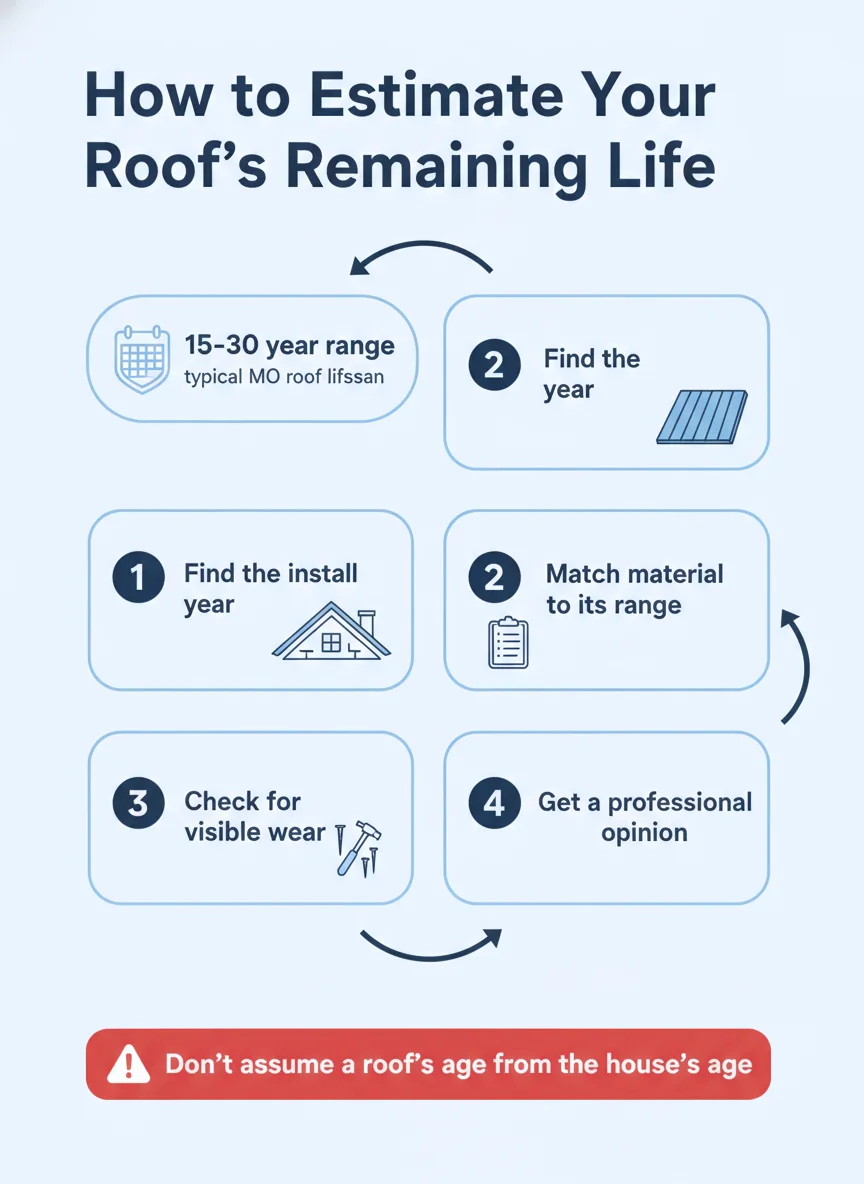
Step-by-step: How to Estimate Your Roof's Remaining Life
You don't need to climb onto the roof to get a rough sense of where it stands. These steps combine records, visible inspection, and a professional opinion to give you a realistic picture.
- Find the install year: Check permit records, a seller's disclosure, or old paperwork to confirm when the current roof was actually installed, not just when the house was built.
- Match the material to its range: Compare the install year against the typical lifespan range for that specific material to see roughly where the roof stands today.
- Walk the perimeter: From the ground, look for curling shingle edges, missing granules in the gutter runoff, or visible rust streaks on metal panels.
- Check the attic: Look for daylight through the decking, water stains on the underside of the roof, or damp insulation, all signs of a compromised roof surface.
- Note any past repairs: Multiple patch repairs on the same roof section usually mean that area is wearing out faster than the rest of the roof.
- Get a professional opinion: A roofer can check flashing, decking, and ventilation up close, details that aren't visible from the ground or a quick attic check.
What You'll Find When a Roof Is Nearing the End
Signs on Asphalt and Architectural Shingles
Curling or cupping at the shingle edges is usually the clearest sign of age-related wear, since it means the asphalt has lost enough flexibility to stay flat. Bald spots where granules have worn away expose the asphalt mat underneath to direct UV exposure, which speeds up the aging process even further once it starts.
Cracked shingles, especially in valleys or around penetrations, often show up before a widespread leak does. If you're seeing granules building up in the gutters after every rain, that's a sign the shingle surface is shedding material faster than normal wear and tear would explain.
Signs on Metal, Tile, and Flat Roofs
On metal roofing, watch for rust forming around exposed fasteners, loose or popped screws, and fading or chalking of the painted finish. These are usually localized issues early on, which is part of why metal roofs can often be maintained rather than fully replaced for a longer stretch of their lifespan.
On flat or low-slope membrane roofs, ponding water that doesn't drain within a day or two after rain is a red flag, since standing water accelerates membrane breakdown. Blistering, cracking, or seams that have started to lift are signs the membrane is reaching the end of its service life.
DIY vs Calling a Pro
There's a fair amount a homeowner can safely check without any special equipment. Walking the yard with binoculars to look at shingle condition, checking the attic for daylight or stains, and keeping an eye on how much granule debris collects in the gutters are all reasonable DIY checks that give you useful early information.
What you can't safely assess from the ground is the condition of the decking underneath, the integrity of flashing around chimneys and vents, or whether ventilation is adequate for the attic space. Those details require someone who can get up close and knows what normal wear looks like versus a developing problem.
If your roof's age is approaching the upper end of its material's typical range, or you're seeing more than one of the warning signs above, that's the point where a professional evaluation is worth more than another round of guessing from the ground. For a deeper look at how asphalt and metal compare over the long run, it's worth weighing both before deciding on a replacement material.
Planning Ahead for Your Next Roof
Knowing roughly where your roof stands in its lifespan takes the guesswork out of budgeting and planning. It also gives you leverage, whether that's deciding to get a few more years out of a well-maintained roof or deciding it's time to start getting quotes before a small problem becomes an emergency one.
Towns across the region, from Forsyth to Branson West, see the same weather patterns wear down roofs in similar ways, so the lifespan ranges above hold up pretty consistently across the area. When you're ready for a closer look at where your roof actually stands, Full Life Roofing Construction can walk the roof with you and give you a straight answer.
Frequently asked questions
How long does a roof last in Missouri?
It depends on the material. Asphalt shingles typically run 15 to 25 years in this climate, architectural shingles stretch a bit longer, and metal roofing commonly reaches 40 to 60 years with proper installation and maintenance.
Does the age of the house tell me the age of the roof?
No, and this trips up a lot of buyers. A roof can be replaced at any point in a home's life, so the only reliable way to know its age is through permit records, a seller's disclosure, or a physical inspection by a roofing professional.
What shortens a roof's lifespan the most in Missouri?
Repeated freeze-thaw cycles, intense summer UV exposure, and wind-driven storms all accelerate wear here. Poor attic ventilation makes any of these worse by trapping heat and moisture against the underside of the decking.
Can I tell if my roof is near the end just by looking?
You can spot several warning signs from the ground or the attic, like curling or bald shingle edges, granule loss, or rusted metal fasteners. A full evaluation still needs a closer look at the decking and flashing, which is where a professional inspection matters.
Is it cheaper to repair an aging roof or replace it?
That depends on how much of the roof's expected life is left and how widespread the wear is. A roof near the end of its typical range with multiple problem areas is usually a poor candidate for another round of patch repairs.