
Siding protects more than curb appeal
In the Branson and Springfield area, siding takes on sun, wind, and seasonal temperature swings year after year. It's the layer standing between your home's structure and everything the Missouri Ozarks weather throws at it, and when it starts to fail, the damage often isn't visible until it's already reached the wall behind it.
Because siding covers the whole exterior, a quote for replacing it touches a lot of variables at once, from wall shape to trim detail to what's found once the old panels come off. Understanding what actually drives that number helps you evaluate a quote instead of just comparing totals side by side.
Why siding quotes differ from house to house
Two homes with the same square footage can price very differently for siding depending on how many corners, windows, and architectural features break up the wall surface. The material choice matters too, but the labor to fit around detail work is often the bigger factor most homeowners don't expect.
Wall complexity and trim
A simple two-story rectangle with few windows sides faster and cheaper than a home with bay windows, multiple gables, and decorative trim. Every corner, window frame, and transition needs its own cut piece, and that labor adds up regardless of which material you choose.
Homes with a lot of architectural character are beautiful, but they take real time to side correctly, especially matching panel lines around windows so they run level across the whole wall. Rushed trim work is one of the most common places corners get cut on a low bid.
What's found after tear-off
Removing old siding often reveals what's really going on underneath, and sometimes that's soft or water-damaged sheathing that needs to be replaced before new siding goes up. This isn't something a contractor can always see or price accurately from the outside before the old panels come off.
Because this kind of damage isn't visible until the wall is open, it's worth asking any contractor how they handle unexpected sheathing repair in their estimate, so there are no surprises about how that gets addressed if it comes up.
| Factor | Pushes cost down | Pushes cost up |
|---|---|---|
| Wall shape | Simple, few corners | Bays, gables, dormers |
| Sheathing condition | Dry, solid | Rot found at tear-off |
| Trim detail | Minimal window trim | Heavy architectural detail |
| Scope | Full replacement | Partial patch to match old |
What a siding system actually includes
Good siding work is more than panels nailed to a wall. It starts with a moisture barrier underneath, proper flashing around windows and doors, and panels installed with the right expansion gap so they don't buckle in summer heat or crack in winter cold.
Corner posts, J-channel around windows, and starter strips at the bottom of the wall all have to be installed in the right order for the whole system to shed water correctly. Skipping steps to save time on any of these pieces is usually where leaks and warping start showing up years later.
Step-by-step: how a siding job comes together
A siding replacement follows a fairly consistent sequence once the crew is on site, even though the details vary by home.
- Remove old siding: Panels and trim are stripped off the wall to expose the sheathing underneath for inspection.
- Inspect sheathing: The crew checks for soft spots, water damage, or rot that needs repair before moving forward.
- Install moisture barrier: A weather-resistant barrier goes on the wall to keep moisture out from behind the new siding.
- Install starter strips and corners: These pieces set the foundation lines the rest of the panels will follow.
- Hang panels: Siding goes up with proper spacing for expansion, working section by section around the home.
- Fit trim and detail work: Window, door, and corner trim get cut and fitted to close out the job cleanly.
Diagnosing what your current siding is telling you
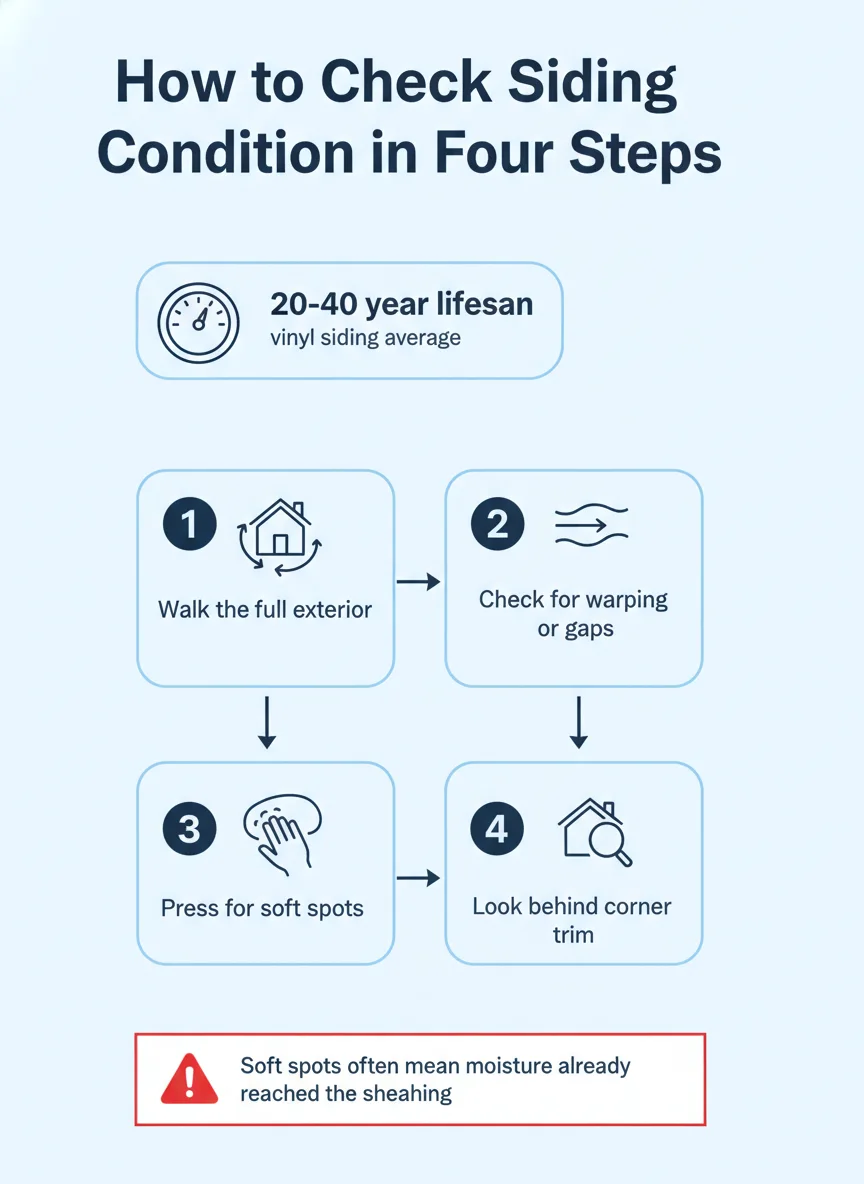
Warping, fading, or gaps between panels are all signals worth paying attention to before they turn into a bigger repair. What each symptom means depends on where you're seeing it and how it's changed over time.
Warping or buckling panels
Warped or buckled panels usually mean the siding was installed too tight, without room to expand and contract with temperature swings. This is a common issue with older installs and tends to show up worse on walls that get the most direct afternoon sun.
In most cases, warped panels need to be replaced rather than repaired, since the material itself has already been stressed beyond its normal shape. It's a good sign to get the whole wall section looked at rather than just the worst-looking panel.
Soft spots or discoloration
A soft spot you can press in with your hand, or a discolored patch that doesn't match the rest of the wall, often means moisture has already gotten behind the siding. This is worth checking sooner rather than later, since moisture trapped behind panels can spread to the sheathing.
Catching this early, before it spreads across a whole wall section, usually means a smaller repair instead of a full wall replacement. It's one of the more urgent signs to act on compared to cosmetic fading.
What a homeowner can check versus what needs a pro
Walking your home's exterior a couple times a year to look for warping, gaps, or discoloration is something any homeowner can do, and it's the best early warning system you have. Catching a problem while it's still cosmetic is a lot cheaper than catching it once it's structural.
Actually removing and replacing siding, especially anything involving sheathing repair or moisture barrier work, needs a licensed crew with experience matching panel lines and flashing details correctly. Getting this wrong doesn't just look bad, it can let water back in behind the new material.
If you're seeing a soft spot, a warped section, or just siding that's showing its age, a professional look at it will tell you whether you're facing a patch job or a full wall replacement. That distinction changes the whole scope of the project.
Reading a siding quote with confidence
A siding estimate that accounts for wall complexity, expected sheathing condition, and trim detail is going to be more accurate than one based purely on square footage. Asking a contractor to walk you through how they arrived at their number is a fair question, and a good one should be able to explain it clearly.
If your siding is warping, softening, or just past its useful life, it's worth getting it looked at before the next season of sun and temperature swings does more damage. Full Life Roofing Construction can take a look at your home's exterior and tell you what condition it's actually in.
Frequently asked questions
Why does siding cost vary so much between homes of similar size?
Siding cost varies mainly because of wall complexity, not just square footage, since homes with more corners, windows, and trim detail need more cutting and fitting labor. The condition of the sheathing underneath also plays a big role if repairs are needed before new siding goes up.
Does removing old siding add much to the price?
Yes, tear-off and disposal of old siding adds labor that a fresh install over new construction doesn't require. It also gives the crew a chance to check the sheathing underneath for moisture damage before it gets covered back up.
Is it worth replacing all the siding if only one wall is damaged?
It depends on the age and condition of the rest of the siding, since matching an older product exactly can be difficult once a style is discontinued. If the rest of the siding still has years of life left, a partial repair on just the damaged wall is often the more practical choice.
How much does trim and detail work affect siding cost?
Trim around windows, doors, and corners adds real labor time because each piece has to be cut and fitted individually rather than run in long straight panels. Homes with more architectural detail will always cost more to side than a simple rectangular structure.
Does insulation get added when siding is replaced?
Insulation can be added during a siding replacement if the sheathing is exposed anyway, and it's a reasonable time to consider it since the wall is already open. Whether it's worth the added cost depends on your home's current insulation and how much of a difference it would realistically make.