
Why storm prep matters for the Branson and Springfield area
Homes across Merriam Woods, Branson, and the surrounding towns deal with their share of fast-moving spring and summer weather, and a roof that's otherwise in good shape can still take a hit when wind and debris show up together. The homes that come through these events with the least damage usually aren't newer or fancier, they're just better prepped.
A five-minute walk-around before the forecast turns ugly won't stop a severe storm from doing what it's going to do, but it puts you in a much better position afterward. You'll know what your roof looked like before, you'll have cleared the easy problems, and you'll know exactly where to look once the weather clears.
Why a few minutes of prep actually changes the outcome
Most storm damage to a roof system isn't a single dramatic event, it's wind and water finding the weak point that was already there. Clogged gutters, loose branches, and unsecured yard debris all turn ordinary wind and rain into something that can lift shingles, dent metal, or pull a gutter loose.
What wind does to an unprepared roof
Wind doesn't need to be extreme to cause trouble if shingles are already lifting at the edges or a branch is hanging close enough to scrape the surface during gusts. Shingle roofing systems are built to shed wind when they're properly sealed, but age and loose edges change that math fast.
Overhanging limbs are one of the easiest things to fix ahead of time. A branch that looks harmless on a calm day can whip against shingles or metal panels for hours during a windstorm, wearing through a surface that would've otherwise held up fine.
What water does when gutters are already full
A gutter system that's doing its job moves water away from the roofline, the fascia, and the foundation. When it's clogged with leaves and debris, heavy rain backs up instead, and that standing water can work its way under shingle edges or behind fascia boards during a long storm.
Our Gutters crews see this pattern often: a roof that's otherwise sound but a gutter system that hasn't been cleared in a season or two, and the water damage shows up at the fascia line first, not the roof deck.
| Before the storm | During the storm | After the storm |
|---|---|---|
| Photograph roofline and gutters | Stay off the roof entirely | Walk the yard, look up from the ground |
| Clear gutters and downspouts | Watch for leaks near the attic access | Check attic for stains or daylight |
| Secure loose yard items | Keep an eye on overhanging limbs | Compare to your before photos |
| Trim branches near the roof | Avoid windows facing the wind | Call a pro if anything looks off |
What's actually at risk during a bad storm
The roof deck, the shingles or metal panels on top of it, the gutter system, and the siding are the four surfaces most exposed during high wind and heavy rain. Each one fails differently, which is part of why a single ground-level check can catch most of what matters.
Siding takes wind-driven rain and debris impact differently than a roof does, and a loose panel or gap at a corner can let water behind the wall just as easily as a lifted shingle lets it into the attic. It's worth a look at the same time you're checking the roofline.
Step-by-step: your 5-minute storm prep checklist
Run through this before the weather arrives, ideally with enough daylight left to actually see what you're looking at.
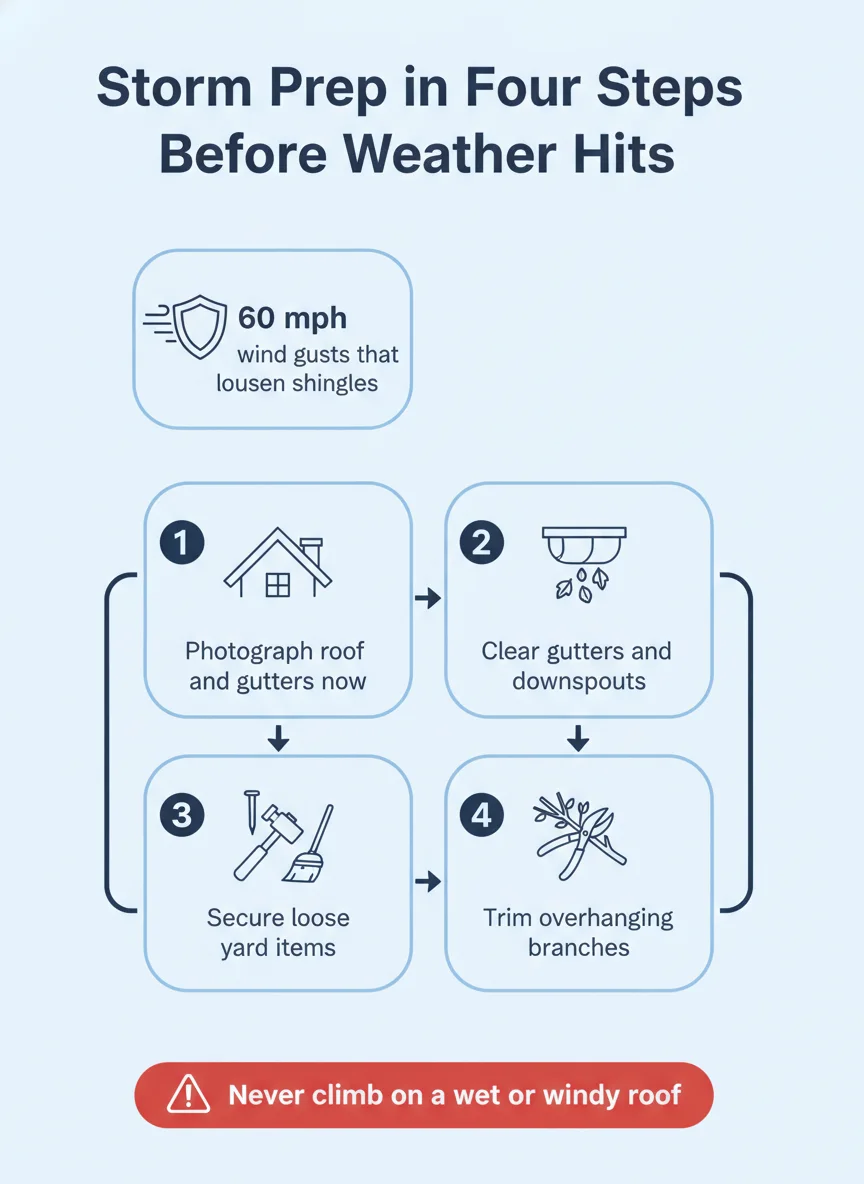
- Take before photos: Walk around the house and photograph the roofline, gutters, and any visible siding from the ground. This gives you a clear comparison point afterward.
- Clear gutters and downspouts: Scoop out leaves and debris so water has a clear path off the roof during heavy rain.
- Secure loose items: Bring in or tie down patio furniture, trash cans, and anything else that could become a projectile in high wind.
- Trim overhanging branches: Cut back limbs that hang over or near the roofline so they can't scrape or drop onto the surface during gusts.
- Know your attic access: Locate the attic hatch or door so you can check for leaks quickly once the weather passes.
- Know your water shutoff: Find the main water shutoff ahead of time in case a line is compromised during the same event.
- Check the morning after: Walk the yard and look up for missing shingles, dented metal, or sagging gutters, and compare to your before photos.
What are you actually looking for the morning after?
The morning-after check is where most homeowners catch something before it turns into a bigger problem, and it only takes a few minutes with your eyes on the ground.
Signs on the roof itself
Look for shingles that are missing, curled, or sitting at an odd angle compared to the rest of the roof. Granules piling up near downspouts are another tell, since that's often a sign the surface took a beating even if nothing looks obviously wrong from the ground.
For metal roofing, check for dents, panels that look loose at the seams, or fasteners that have backed out. Metal holds up well in wind, but a direct hit from debris can still leave a mark worth having someone look at.
Signs inside the house
Check the attic for new water stains on the decking, insulation that feels damp, or daylight coming through where it shouldn't. These signs show up faster than you'd expect after a bad storm, sometimes within hours.
Ceiling stains on the top floor are another signal worth checking, especially in rooms you don't walk through daily. A small stain today is a lot easier to deal with than the same leak six months from now.
What should you handle yourself, and when do you call a pro?
Clearing gutters, trimming branches, securing yard items, and photographing your home beforehand are all things any homeowner can safely do, and they're the prep steps that matter most. None of it requires special equipment or going up a ladder onto the roof itself.
Anything involving getting on the roof, whether that's a close inspection or a repair, is where it's worth bringing in a licensed roofer. That includes checking for lifted shingles up close, resetting loose flashing, or getting on a ladder to look at a gutter section that's pulled away from the fascia.
If your morning-after check turns up anything questionable, even something small, it's worth getting a second set of eyes on it before the next round of weather comes through. A loose shingle or a sagging gutter section rarely gets better on its own.
Building storm prep into your routine
Storm prep works best when it's a habit, not a scramble every time a forecast looks bad. Keeping your gutters clear through the season, trimming branches as they grow, and snapping a few photos of your roofline every so often means you're never starting from zero when weather rolls in.
If you'd rather have a second opinion on what your roof and gutters can handle before the next storm, or you spotted something during your morning-after check that didn't look right, Full Life Roofing Construction is glad to take a look.
Frequently asked questions
What should I do to my roof before a storm hits?
Start by taking photos of your roofline and gutters so you have a clear before picture, then clear debris from gutters and downspouts so water has somewhere to go. Secure or bring in anything in the yard that could blow into the roof, and trim back branches that hang over the house.
Should I clean my gutters before a storm in Missouri?
Yes, clogged gutters and downspouts are one of the fastest ways a heavy rain event turns into water finding its way under shingles or into fascia. A few minutes with a hose or a quick scoop-out before the forecast turns is worth it.
What should I check on my roof the morning after a storm?
Walk the yard and look up from the ground for missing or curled shingles, granules collecting near downspouts, dented metal, or sagging gutters. Check the attic for new water stains or daylight coming through the decking, and compare what you see to your before photos.
Is it safe to inspect my own roof after bad weather?
A ground-level walk-around is safe and tells you a lot, but getting on the roof itself right after a storm is not something we recommend for homeowners. Wet or damaged decking can give way without warning, so leave the up-close look to a professional.
Where is the attic access and water shutoff in my home, and why does it matter before a storm?
Knowing both locations before weather hits means you're not searching for them in the dark if a leak starts. The attic access lets you check for water intrusion quickly, and the water shutoff can limit damage if a line fails during the same event.