
Why choosing the right roofing company matters more than it seems
A roof is one of the more expensive systems on a home, and it's also one of the hardest for a homeowner to inspect themselves once the work is done. That combination, high cost and low visibility, is exactly why the roofing industry has more than its share of companies that cut corners, disappear after a storm, or leave a job half-finished. Picking the right company up front saves you from finding out about a bad install years later when a leak shows up.
Across Missouri, homeowners deal with everything from ice and freeze-thaw cycles in winter to strong spring storms, and a roof installed poorly for those conditions won't hold up as long as one done right. Taking the time to vet a contractor before signing anything is worth the extra week it might take.
Why so many roofing complaints trace back to the hiring stage
Most roofing horror stories, the ones about leaks reappearing months after a replacement or a crew that vanished mid-job, don't start with bad luck. They start with a homeowner skipping a step during the hiring process, usually because a quote looked good or a salesperson created urgency to sign quickly.
Licensing and insurance
Missouri doesn't have a statewide contractor license requirement for roofing, which means the burden falls on the homeowner to ask directly about insurance. A legitimate roofing company should carry general liability insurance and worker's compensation coverage, and should be willing to provide proof of both without hesitation.
If a company is vague about insurance or says it's "not necessary" for a job your size, treat that as a serious warning sign. Insurance protects you if a worker is injured on your property or if the job damages something unrelated to the roof itself.
Reputation and local presence
A company that's been doing business in the same region for a while tends to have a track record you can actually check, through reviews, past customers, or word of mouth. A crew that showed up after a big storm from out of state and has no local address or history is much harder to vet, and much harder to track down if something goes wrong after they've moved on.
Ask how long the company has served your specific area, not just how long they've existed as a business. A company rooted in the Branson & Springfield area, for example, has more at stake in getting your job right than one passing through.
| What to check | Good sign | Warning sign |
|---|---|---|
| Insurance | Provides proof without hesitation | Vague or avoids the question |
| Quote | Itemized, written, explains scope | Verbal only, vague total |
| Warranty | Clear terms in writing | Says 'we'll take care of you' with no document |
| Local presence | Established local address and history | No fixed address, out-of-town crew |
What a quote should actually contain
A real roofing quote is a written document that breaks down materials, labor, and the specific scope of work, not just a single total number. It should specify what's being replaced, what stays, and what the timeline looks like. If a quote is verbal only, or if the written version is just a bottom-line price with no breakdown, you have no way to compare it fairly against another company's estimate.
It's also worth asking how the quote was arrived at. A company that walked the roof, checked the attic, and measured before quoting is giving you a number based on your actual situation. A quote given over the phone or from a drive-by look is a guess dressed up as a number.
Step-by-step: vetting a roofing company before you sign
Here's a practical order to work through when you're comparing roofing companies, whether you're getting a repair or a full replacement.
- Ask for insurance proof: Request documentation of general liability and worker's comp coverage before any crew sets foot on your property.
- Get it in writing: Insist on a written quote that breaks down materials, labor, and the specific scope of the job, not just a total.
- Ask about warranty terms: Get clear on what the manufacturer covers versus what the contractor's own workmanship warranty covers and for how long.
- Check local history: Ask how long the company has served your area specifically and look for reviews or references you can actually verify.
- Compare at least two quotes: A second opinion helps you spot whether a price is in line with the market or an outlier in either direction.
- Ask about the diagnosis: A company that explains specifically what they found, not just a price, is showing you they actually inspected the roof.
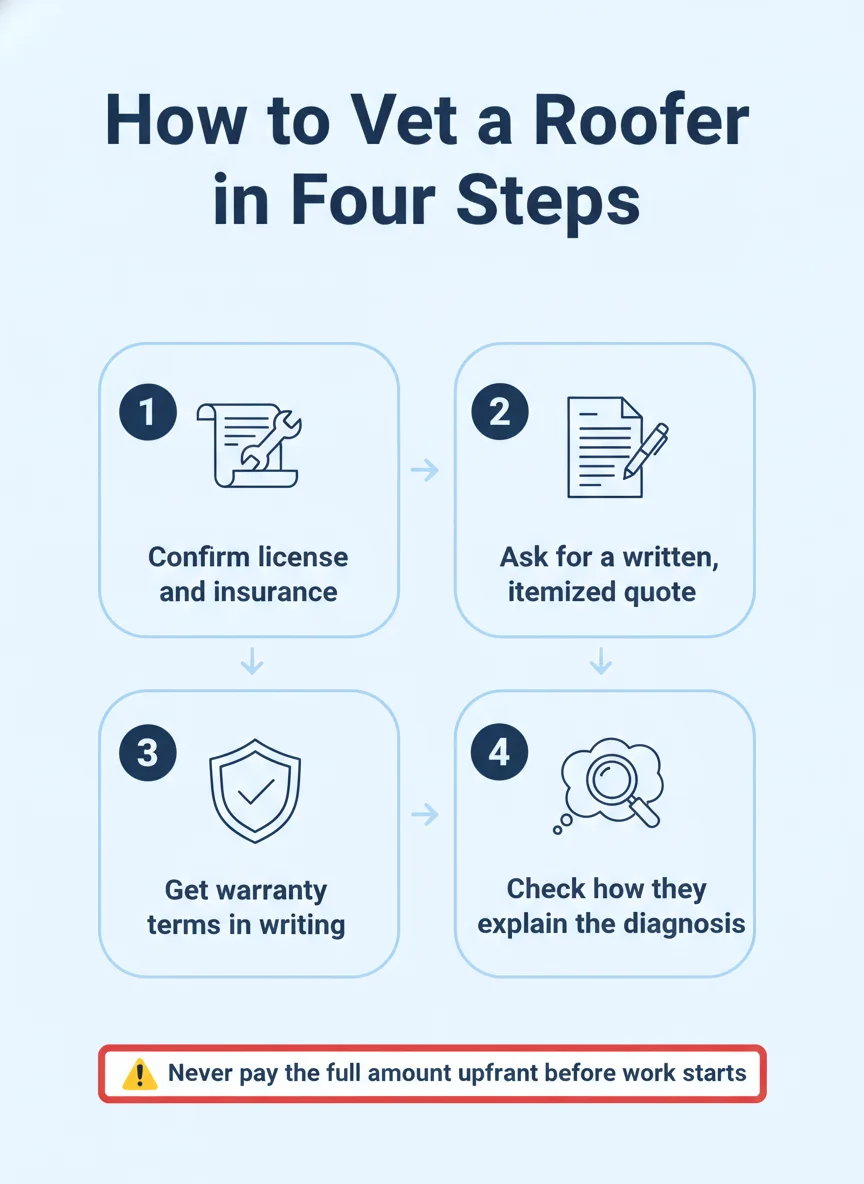
What a real diagnosis looks like versus a sales pitch
Signs of a genuine inspection
A thorough roof check includes time in the attic looking for daylight, staining, or damp insulation, not just a walk around the exterior. The person doing the inspection should be able to point to specific areas of concern, whether that's a particular slope, a flashing point, or a section of decking, and explain why it matters.
If you ask a follow-up question and get a clear, specific answer rather than a repeated sales pitch, that's a good sign you're dealing with someone who actually looked at your roof rather than reciting a script.
Signs of a rushed sales pitch
Watch for language that creates urgency without substance, phrases like "this deal is only good today" or pressure to sign before getting a second opinion. A company confident in its work and pricing generally doesn't need to rush you into a decision the same day you meet them.
Also be cautious of anyone quoting a full roof replacement without ever getting on the roof or into the attic. A price based on a drive-by look, with no direct inspection, isn't grounded in your home's actual condition.
What you can check yourself vs what needs a pro's eyes
You can and should check a company's reviews, ask for references, and confirm insurance documentation entirely on your own before ever scheduling an inspection. These background checks take an afternoon and cost nothing.
Once you're comparing actual roof conditions and repair recommendations, that's where you rely on the contractor's inspection, since diagnosing decking damage, flashing failures, or ventilation issues requires someone trained to spot them. This is also where getting a second opinion matters, since two companies inspecting the same roof should generally agree on the major findings even if their pricing differs.
The general rule: background checks and paperwork review are yours to do. The technical diagnosis of what's actually happening on and under your shingles belongs to a licensed roofer who's physically inspected the roof and attic.
Making the final decision
Choosing a roofing company in Missouri comes down to checking the basics, insurance, a written and itemized quote, clear warranty terms, and a local track record, before you ever get to comparing prices. A company that's confident in its work will answer every one of these questions directly without hesitation.
Full Life Roofing Construction serves homeowners across the Branson & Springfield area and is happy to walk through any of these questions before you decide who does the work.
Frequently asked questions
How do I check if a roofing company is licensed in Missouri?
Missouri does not require a statewide roofing license, so requirements vary by city and county. It's worth asking directly whether the company carries liability insurance and worker's comp coverage, since those protect you if something goes wrong on the job.
What's a red flag in a roofing quote?
A quote with no breakdown of materials, labor, and scope of work is a common red flag, since it makes it hard to compare against other estimates. Pressure to sign the same day or a price that seems far lower than every other quote you've gotten are also worth pausing on.
What warranty questions should I ask a roofer?
Ask what's covered under the manufacturer's material warranty versus the contractor's workmanship warranty, since those are two separate things with different terms. Also ask how long the workmanship coverage lasts and what voids it.
What does a real roof diagnosis look like?
A thorough diagnosis includes a look at the attic from the inside, not just a walk around the outside of the house. A roofer who explains specifically what they found and why it matters, rather than just naming a total price, is doing the job right.
Should I get multiple quotes before hiring a roofer?
Yes, getting two or three quotes gives you a sense of the going rate and lets you compare how thoroughly each company explains their findings. A wide gap between quotes is worth asking about directly rather than just picking the cheapest one.