
Why attic airflow matters across the Ozarks
Homes around Branson, Springfield, and the surrounding towns see both sides of Missouri weather, muggy summers and cold snaps with real snow load. An attic has to handle both, staying cool enough in July to protect the shingles and dry enough in January to keep ice dams from forming at the eaves. When the ventilation system isn't balanced, the attic works against the roof instead of for it.
Most homeowners never think about their attic until something shows up as a symptom somewhere else, a hot upstairs bedroom, a musty smell, a line of icicles that wasn't there last winter. Those are all downstream signs of the same upstream issue, and catching it early usually means a smaller fix than waiting until the roof deck or insulation has taken damage.
What's actually happening up there
Attic ventilation works on a simple idea: cooler air comes in low, at the soffits, and warmer air exits high, at the ridge or through roof vents. When that exchange is blocked or undersized, heat and moisture have nowhere to go, and they sit against the underside of the roof deck instead.
Inadequate attic ventilation
This is the most common root cause and shows up as heat buildup in summer and moisture buildup in winter. Vents can be undersized for the attic's square footage, blocked by insulation, painted shut, or simply missing on one side of the roof, so air comes in but has no way out.
The fix depends on what's already there. Sometimes it's a matter of clearing existing vents, other times the attic genuinely needs more intake or exhaust capacity added, which is a job for a licensed Shingle Roofing contractor since it involves working on the roof deck itself.
Moisture from fans venting into the attic
Bathroom and kitchen exhaust fans are supposed to carry humid air all the way outside. In a lot of older homes, and even some newer builds, that ductwork was never run through the roof or wall and just dumps into the attic instead. Every shower adds moisture to a space that has no way to dry out.
Over months and years, that moisture condenses on the underside of the roof deck and on any metal it touches, leading to staining, wood softening, and eventually mold. It's an easy thing to miss because the fan still sounds like it's working.
| Season | Common Symptom | Root Cause |
|---|---|---|
| Summer | Upstairs rooms stay hot after sundown | Heat trapped due to inadequate ventilation |
| Winter | Icicles and ice buildup along the eave | Heat loss melting snow, refreezing at cold overhang |
| Year-round | Musty smell or dark staining on rafters | Moisture from unvented fans or poor air exchange |
The parts that make up the system
A working attic ventilation system has two halves that need to stay in balance. Intake vents, usually along the soffit under the eave, let cooler outside air into the attic low and slow. Exhaust vents, at or near the ridge, let warm air escape at the highest point, pulling fresh air in behind it in a continuous cycle.
Insulation plays a supporting role too. It's meant to keep conditioned air in the living space below, not in the attic, so the attic itself stays close to outdoor temperature. When insulation is pushed up against the roof deck or piled over soffit vents, it blocks the very airflow it's supposed to work alongside.
Step-by-step: what a ventilation visit looks like
A typical visit takes about an hour and covers the attic space from the soffits to the ridge before any work is discussed.
- Exterior walk-around: We look at the roofline from the ground first, checking for visible vent types, ridge condition, and any obvious signs like staining below the eaves.
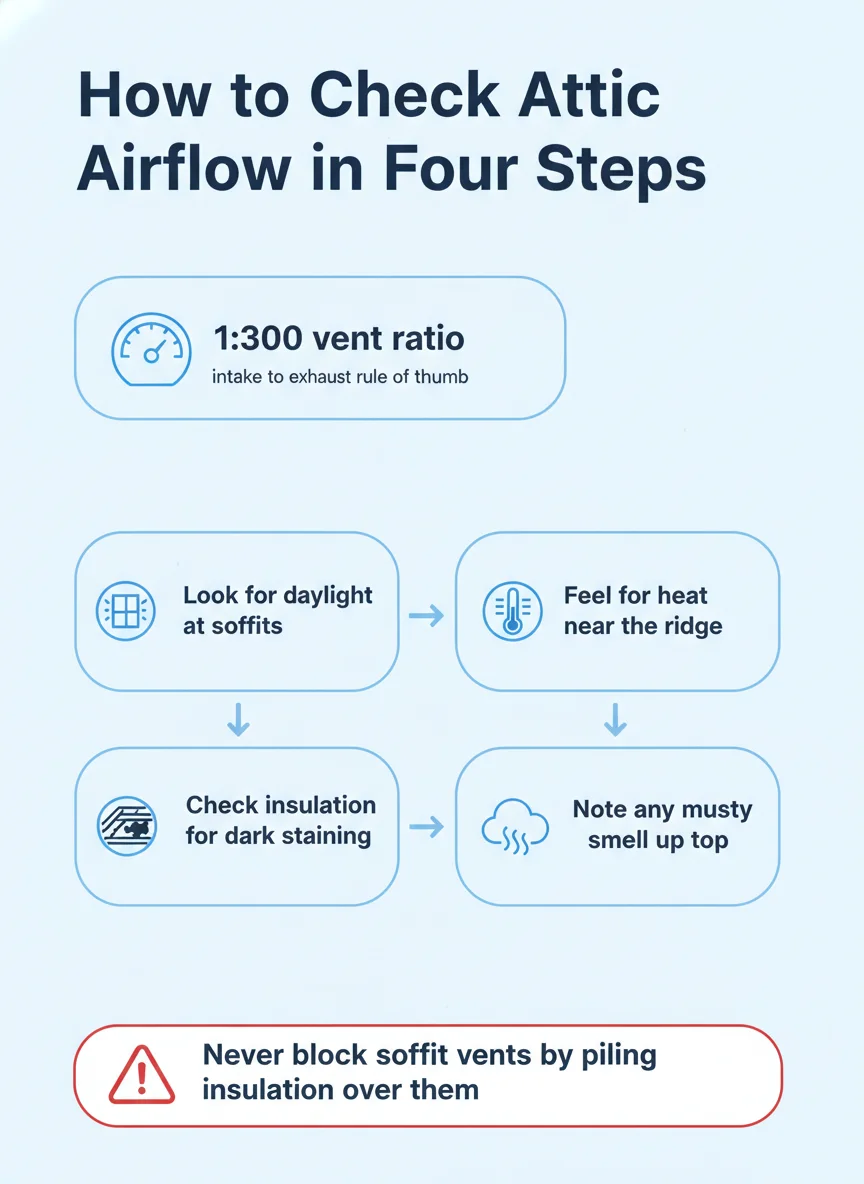
- Attic entry: We go up into the attic itself to check temperature, look for daylight gaps at the soffits, and note any musty smell or condensation.
- Insulation check: We look at insulation depth and placement, especially near vents, since blocked soffits are one of the most common causes we find.
- Vent count and sizing: We estimate whether the current intake and exhaust vents are sized for the attic's square footage or if the system is undersized.
- Fan duct trace: Where accessible, we trace bathroom or kitchen exhaust ducts to confirm they vent outside rather than dumping into the attic.
- Findings walkthrough: We walk you through what we found in plain language and explain what, if anything, needs attention.
What you'll typically find, and what it means
If the attic runs hot but dry
A hot, dry attic usually points to an exhaust or intake imbalance rather than a moisture source. This is the most common finding in summer and is often solved by adding or unblocking vents rather than any major work.
Left alone, sustained high attic heat can shorten the life of shingles from underneath, since they're taking heat from both directions. It's worth addressing even if nothing looks urgent yet.
If there's visible moisture or staining
Dark staining on rafters or sheathing, or a musty smell, usually means moisture has been sitting in the attic for a while. This points more toward a fan venting incorrectly or a serious airflow imbalance than a one-time event.
This is the finding that deserves the quickest follow-up, since ongoing moisture is what leads to wood rot and mold, both of which get more expensive to fix the longer they sit.
DIY vs. calling a pro
Checking your own attic is something most homeowners can do safely with a flashlight and a mask. Look for daylight at the soffits, feel for excessive heat near the ridge, and note any dark staining on the wood or insulation. None of that requires tools or roof access.
Anything beyond checking, though, belongs with a licensed roofer. Adding or resizing vents means cutting into the roof deck, and rerouting a fan duct often means working through the attic and the roofline together. Getting the intake-to-exhaust balance wrong can make ventilation worse instead of better.
If you've also noticed granules in the gutter or shingles that look older than they should, it's worth reading up on old roof, curling or bald shingles since heat damage from poor ventilation can accelerate that wear.
Getting ahead of it before winter
Attic ventilation problems tend to get worse quietly, one summer and one winter at a time, until an ice dam or a stained ceiling makes them impossible to ignore. Catching the imbalance early, whether that's blocked soffits or a misvented fan, is usually a smaller job than repairing the damage it eventually causes.
Homeowners in Branson and nearby towns dealing with a hot attic, ice buildup, or a musty smell upstairs can have it looked at before it turns into a bigger repair. Full Life Roofing Construction checks attic ventilation as part of a broader roof visit.
Frequently asked questions
Why is my attic so hot in the summer?
A hot attic almost always means air isn't moving through it the way it should. Warm air gets trapped between the insulation and the roof deck instead of exiting through vents, which raises attic temps well above outside air and stresses the shingles from underneath.
What causes ice dams on a roof in Missouri winters?
Ice dams form when heat escaping from the living space warms the roof deck enough to melt snow, which then refreezes at the cold eave. It's a ventilation and insulation issue more than a weather issue, since two houses on the same street in the same storm can have very different results.
Is attic moisture a serious problem?
Yes, ongoing moisture in an attic can rot the roof deck, ruin insulation, and feed mold growth over time. It's usually caused by a bathroom or kitchen fan venting into the attic instead of outside, or by poor overall air exchange.
Can I fix attic ventilation myself?
Some parts, like clearing insulation away from soffit vents, are simple homeowner tasks. Adding or resizing vents, however, involves cutting into the roof deck and should go to a licensed roofer so the balance of intake and exhaust is done correctly.
How long does an attic ventilation inspection take?
A typical inspection runs about an hour, covering the attic space, the vents, and the insulation. That's usually enough time to identify the cause and talk through options before any work is scheduled.