
Flashing Failures Are a Frequent Cause of Leaks Around the Region
Every roof has spots where something breaks through the main surface, a chimney, a skylight, a bathroom vent, or a plumbing pipe, and every one of those spots needs flashing to keep water out. Homes throughout Branson, Springfield, and the surrounding towns see enough seasonal temperature swings and sun exposure that flashing materials wear out well before the shingles or roofing around them.
Flashing problems matter because they're one of the more common sources of a leak that seems to come from nowhere. A homeowner might assume a stain near a chimney means the roofing itself failed, when the actual cause is a small gap in the flashing that's been letting water in gradually for a while.
Why Flashing Wears Out Faster Than the Rest of the Roof
Flashing relies on caulk, sealant, or a tight mechanical fit to stay watertight, and all three of those degrade with sun exposure and repeated expansion and contraction as temperatures swing through the seasons.
Failed Chimney Flashing or Counter-Flashing
Chimney flashing usually comes in two layers, a base flashing tucked under the shingles and a counter-flashing set into the masonry above it. Over time, the seal where the counter-flashing meets the chimney can crack or the metal itself can pull loose from the masonry as the chimney settles slightly.
Once that seal fails, water runs down the chimney's exterior and finds its way behind the flashing during rain, which is why chimney leaks often show up as staining on a wall or ceiling near the fireplace rather than a dramatic drip.
Skylight Flashing Kit or Seal Failure
Skylights come with a flashing kit designed to shed water around all four sides of the unit, and that kit's seals are just as prone to drying out and cracking as any other flashing on the roof, especially since skylights sit in direct sun most of the day.
A skylight leak is easy to blame on the glass or the unit itself, but more often than not it's the surrounding flashing that's actually let water in, which is good news since it usually means the skylight doesn't need full replacement.
| Location | Common Failure | First Sign |
|---|---|---|
| Chimney | Cracked seal or lifted counter-flashing | Stain on nearby wall or ceiling |
| Skylight | Dried or cracked flashing kit seal | Water tracking around the frame edge |
| Vent pipe | Cracked or loose pipe boot | Small stain directly below the vent |
What Flashing Is Actually Doing on Your Roof
Flashing's whole job is bridging the gap between the roof surface and whatever's poking through it, whether that's a chimney, a pipe, or a skylight frame. Shingles alone can't seal around an irregular shape, so flashing steps in to route water around the obstacle instead of letting it pool or seep in.
Because it's doing that job at every seam and joint, flashing is under constant stress from water trying to find any small opening, plus the added wear of sun and temperature changes hitting exposed metal and rubber directly. It's a small piece of the roof system, but a disproportionate amount of leaks trace back to it.
Step-by-step: What Happens During a Flashing Inspection
A flashing inspection typically runs two to four hours, since it usually involves checking every penetration on the roof rather than just the one causing the current problem.
- Check every penetration: We inspect flashing at the chimney, skylights, vents, and pipe boots, since a failure in one usually means the others are aging too.
- Look for gaps and cracks: We check seals, caulk lines, and metal joints closely for cracking, lifting, or rust that would let water through.
- Trace any active leaks: If there's already a known leak, we trace it back to confirm which flashing point is the actual source.
- Check for water damage: We look at the decking near each penetration for softness or staining that would suggest a leak's been going on for a while.
- Recommend the right fix: We explain whether resealing, replacing a section of flashing, or a full flashing replacement makes sense for what we found.
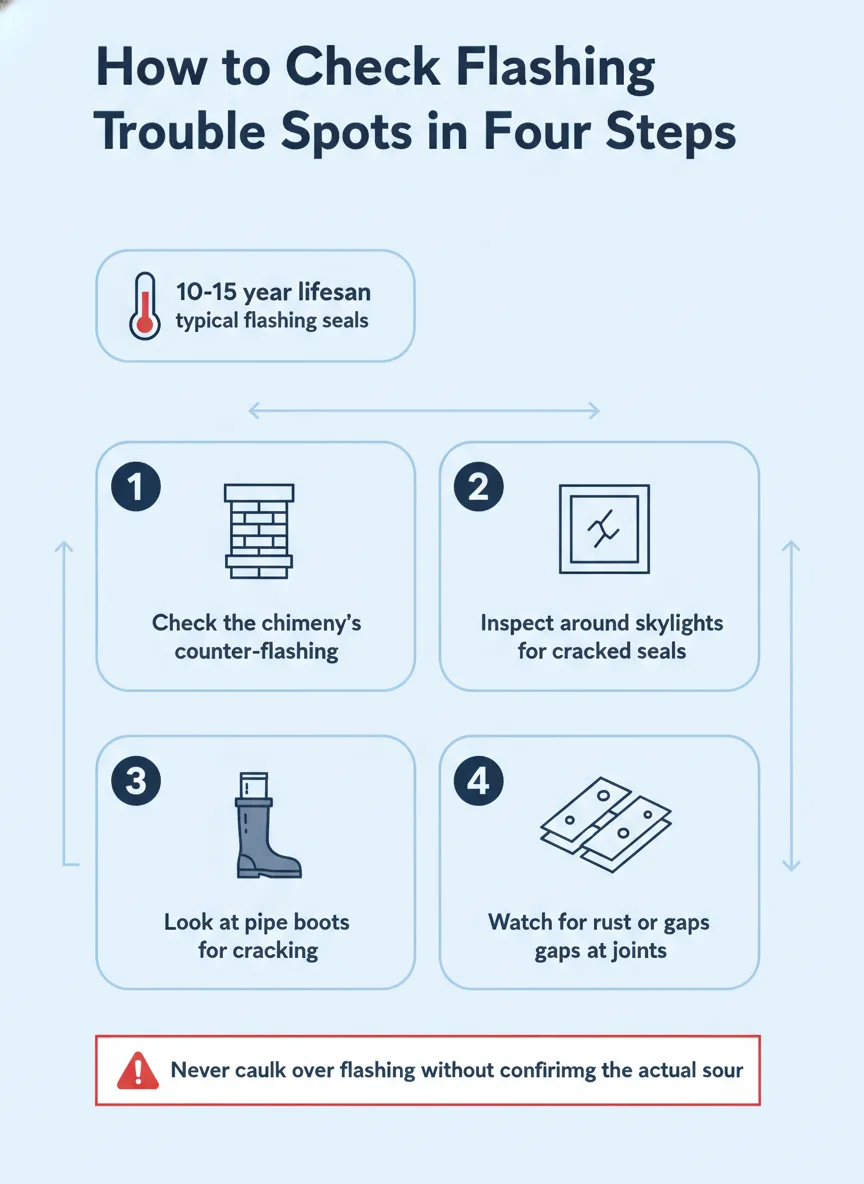
What You're Likely Dealing With, Depending on the Symptom
A Cracked Pipe Boot
If the leak is showing up as a small, isolated stain directly under a bathroom or plumbing vent, a cracked pipe boot is usually the culprit. These are some of the more common flashing failures we see, simply because the rubber sits exposed to direct sun year-round.
The fix is usually straightforward, replacing the boot itself, and it's a repair that's worth doing as soon as it's found since the crack tends to widen with continued sun exposure and temperature swings.
A Chimney or Skylight Leak
If the stain is near a chimney or skylight, the repair is a bit more involved, since it often means resealing or replacing sections of flashing rather than a single small part. Sometimes it also means checking whether water has already reached the decking underneath.
These repairs are worth doing carefully rather than quickly, since a rushed reseal often fails again within a season or two if it doesn't address the full extent of the worn flashing.
DIY vs Calling a Pro
From the ground or from an attic, a homeowner can check for stains near chimneys, skylights, and vents, and note whether they show up consistently after rain. That kind of pattern spotting is genuinely useful information to have before a roofer even shows up.
Actually fixing flashing is more specialized work than it looks. It involves working with metal, rubber seals, and sometimes masonry all in the same repair, and getting the layering right matters, since flashing that's installed out of order can fail faster than the worn flashing it replaced.
A licensed roofer also knows which flashing failures are quick fixes and which point to a bigger issue with the surrounding roofing, which isn't always obvious from a homeowner's vantage point on a ladder.
Getting Ahead of a Flashing Leak
Flashing failures are some of the easiest leaks to miss because the damage often shows up far from where the actual problem is. A stain near a chimney or skylight is worth taking seriously even if it seems minor, since these leaks tend to keep going until the flashing itself is addressed.
If you're seeing signs of a flashing issue around a chimney, skylight, or vent, it's worth getting it checked before the next rain adds to the damage. Homeowners in Forsyth and nearby towns dealing with an aging roof overall might also find our guide on curling shingles useful context. Full Life Roofing Construction handles flashing repairs as part of regular roof maintenance across the area.
Frequently asked questions
What is roof flashing and why does it fail?
Flashing is the metal or rubber material sealing the gaps where a roof meets a chimney, skylight, vent pipe, or another roof section. It fails over time as caulk dries out, metal rusts, or rubber seals crack from years of sun and temperature swings.
How do I know if my chimney flashing is leaking?
A leak near the chimney often shows up as a stain on the ceiling or wall closest to it, especially after heavy rain. Cracked or lifted counter-flashing, or gaps where the flashing meets the masonry, are the usual visible clues.
Can a skylight leak be fixed without replacing the skylight?
Often yes, since many skylight leaks come from a failed flashing kit or seal around the unit rather than the skylight itself. Replacing or resealing the flashing usually solves the problem without needing a new skylight.
Why does a pipe boot crack over time?
Pipe boots are usually made of rubber or plastic that sits exposed to direct sun and temperature swings year-round, which causes the material to dry out and crack eventually. This is one of the more common sources of small leaks on an otherwise healthy roof.
Is flashing repair a quick fix or a bigger job?
It depends on what's failed and how far the damage has spread. A cracked pipe boot is usually a quick, targeted repair, while chimney flashing that's been leaking for a while might involve checking the decking underneath for damage too.