
Why Do Roofs in the Ozarks Get Black Streaks?
If you've noticed dark, wavy lines creeping across your shingles, especially on the side of the roof that stays shaded most of the day, you're not imagining dirt buildup. Across the Branson and Springfield area, humid summers and plenty of tree cover create ideal conditions for a type of algae that thrives on asphalt shingles. It shows up gradually, often starting near the ridge and working its way down the slope over several seasons.
It matters because homeowners often assume it's mold, soot, or a sign the roof is failing, which leads to the wrong fix. Scrubbing it with a pressure washer or the wrong cleaner can strip away the granules that protect your shingles from sun damage, turning a cosmetic issue into a real one. Understanding what's actually growing up there is the first step to treating it the right way.
What's Actually Causing Those Streaks?
The organism responsible is a blue-green algae called Gloeocapsa magma. It feeds on the limestone filler used in most asphalt shingles and produces a dark, protective coating as it grows, which is what you see as the streaking. It spreads through airborne spores, so it's common to see it jump from one roof to a neighbor's within a few years, particularly in areas with high humidity and limited direct sun.
Why North-Facing and Shaded Slopes Show It First
Algae needs moisture to survive, and shaded slopes hold onto morning dew and rainfall far longer than slopes that get full sun throughout the day. A north-facing roof plane, or one shaded by mature trees, simply stays damp longer, giving the algae the conditions it needs to take hold and multiply.
This is why streaking often looks uneven across a single roof. The sunnier south and west slopes may stay nearly clean for years while the shaded north slope darkens noticeably sooner. It's a pattern worth checking during any routine look at your Shingle Roofing, since it tells you where moisture is lingering longest.
Why It Spreads From the Ridge Down
Rainwater runs from the ridge of the roof down to the eaves, and as it travels it carries algae spores with it. That's why streaking frequently appears as vertical or diagonal lines fanning out from the ridge rather than as an even haze across the whole slope.
Gutters and downspouts play a role here too. If water is sheeting off the roof slowly or pooling near the edge, that extra dwell time gives algae more opportunity to establish itself near the eaves before it's ever noticed higher up the slope.
| Method | What It Does | Risk to Shingles |
|---|---|---|
| Soft wash with mild solution | Breaks down algae without high water pressure | Low risk when done correctly |
| Pressure washing | Blasts algae and granules off the surface | High risk, can void warranties |
| Stiff brushing or scraping | Physically removes surface staining | Moderate to high risk of granule loss |
| Zinc or copper strips | Releases metal ions that slow regrowth over time | Low risk, preventive only |
What Are Algae-Resistant Shingles?
Algae-resistant shingles are manufactured with small amounts of copper or zinc embedded directly into the granules. As rain washes over the surface, those metals release in tiny amounts that discourage algae from establishing a foothold, which keeps the roof looking cleaner for a much longer stretch of time compared to standard shingles.
They don't make a roof completely immune to streaking forever, but they slow it down significantly, which matters most on shaded or north-facing slopes where algae tends to show up first. If you're planning a replacement down the road, it's worth asking whether algae-resistant options fit your budget and the shade conditions around your home.
Step-by-step: Treating Existing Streaks Safely
If your roof already has visible staining, the goal is to remove it without damaging the shingle surface underneath. A careful, low-pressure approach protects the granules while still clearing the discoloration.
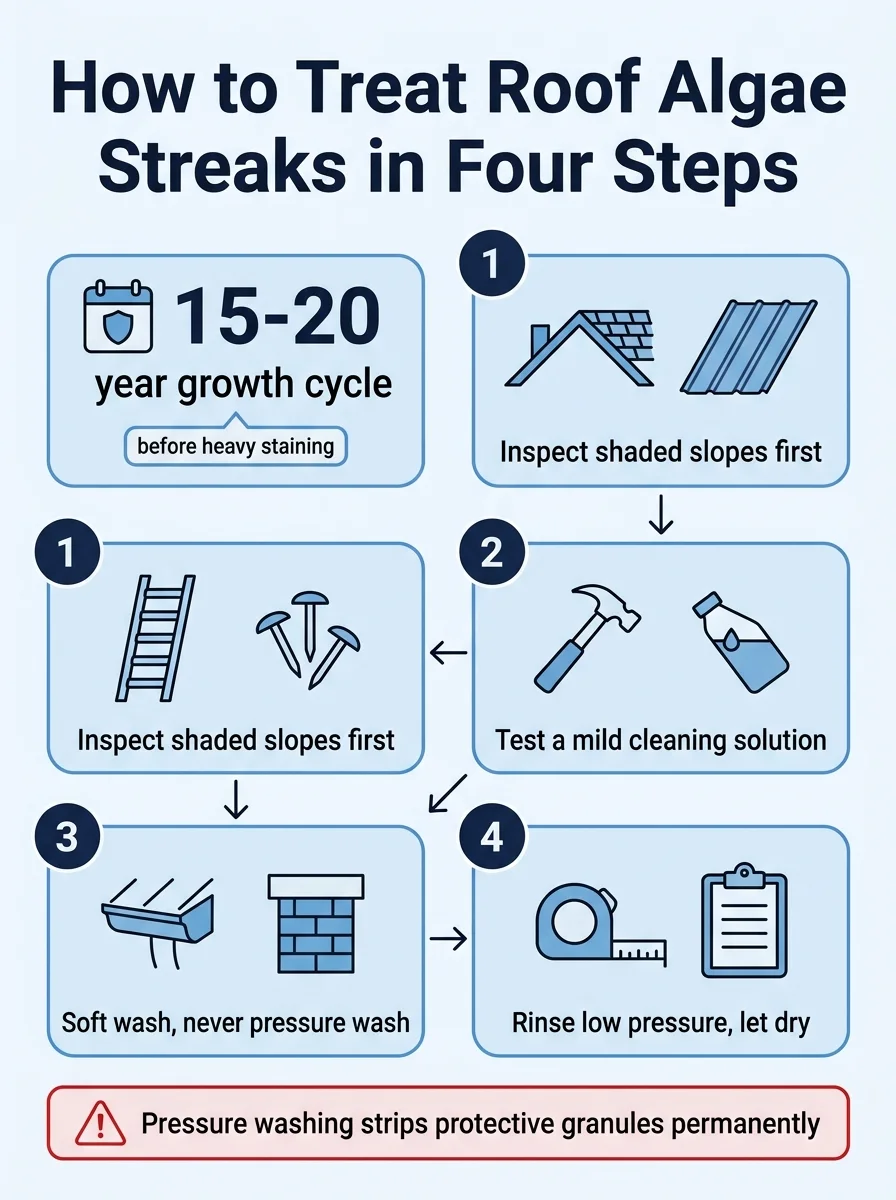
- Inspect shaded slopes first: Walk the property and note which slopes show the heaviest streaking, since those will need the most attention and the closest follow-up monitoring.
- Test a mild cleaning solution: Try a small, inconspicuous patch with a manufacturer-approved or mild cleaning solution before treating the whole roof, to confirm it won't discolor or damage the shingles.
- Apply with a soft wash system: Use a low-pressure sprayer rather than a pressure washer so the solution can break down the algae without blasting away protective granules.
- Rinse at low pressure: Rinse the treated area with a garden hose or low-pressure setting, working from the ridge down to follow the natural water flow off the roof.
- Let the roof dry fully: Give the shingles time to dry before walking the roof again or applying any additional treatment, since wet shingles are more prone to damage from foot traffic.
- Trim back overhanging branches: Cutting back limbs that shade the roof reduces moisture dwell time and can slow how quickly algae returns after cleaning.
- Ask about resistant shingles at replacement: When it's time for a new roof, ask whether algae-resistant shingles make sense for your home's shade and humidity exposure.
Is It Just Algae, or Something Worse?
When It's Just Algae
Classic algae streaking looks like dark, wavy lines or splotches that follow the water flow pattern down the slope, usually concentrated on shaded or north-facing areas. The shingles underneath still lie flat and feel intact, and there's no accompanying sagging, curling, or missing granules in large patches.
If that matches what you're seeing, the streaking is almost certainly cosmetic. It's worth monitoring and treating when it bothers you, but it's not, on its own, a sign that the roof needs replacement or immediate repair.
When Streaks Signal a Bigger Problem
Streaking paired with other symptoms is a different story. If you also notice curling or bald shingles, soft spots underfoot, or granules collecting heavily in the gutters, the roof may be dealing with age-related wear rather than simple surface algae.
In that case, cleaning alone won't solve the underlying issue, and continuing to treat the surface cosmetically can delay a repair the roof actually needs. A closer look at the decking and shingle condition, not just the surface color, is the way to tell the difference.
DIY Cleaning vs. Calling a Roofing Pro
Light algae staining on a single-story, walkable roof with a gentle pitch is reasonable for a confident homeowner to treat with a garden hose, a soft wash attachment, and a mild solution applied carefully from the ground or a stable ladder. The key is patience and low pressure, not speed.
Steeper pitches, two-story roofs, or extensive staining are better left to a professional with the right equipment and fall protection. A roofing crew can also tell the difference between surface algae and early granule loss while they're already up there, which is hard to judge accurately from the ground.
If you're unsure which situation you're in, or you've noticed streaking alongside other changes like sagging or missing shingles, it's worth having a professional take a look before you climb up with a hose and a bottle of cleaner.
Keeping Ozarks Roofs Looking Their Best
Black streaking is common across the Branson and Springfield region simply because of the humidity and tree cover that make this part of Missouri such a pretty place to live. Treated carefully and monitored over time, it's a manageable part of owning a home here rather than an emergency.
Whether you're weighing a safe cleaning approach for an existing roof or considering algae-resistant shingles for a future replacement in Branson or the surrounding towns, Full Life Roofing Construction can walk through the options that fit your home.
Frequently asked questions
What causes black streaks on a roof?
Black streaks on asphalt shingles are almost always a type of algae called Gloeocapsa magma, not dirt, mold, or soot. It feeds on the limestone filler in shingles and spreads over time, especially in humid climates.
Does black roof algae damage the shingles?
On its own, algae is mostly cosmetic and doesn't eat through the shingle, but it does trap moisture against the surface and can shorten shingle life over many years. Left unchecked long enough, it can contribute to granule loss.
Can I pressure wash algae off my roof?
No, pressure washing is one of the fastest ways to void a shingle warranty and strip the protective granules that shield shingles from UV. A low-pressure soft wash with the right solution is the safer approach.
Will black streaks come back after cleaning?
Yes, algae spores are still present in the environment and on neighboring roofs, so streaking often returns within a few years unless the roof is replaced with algae-resistant shingles. Regular light cleaning can slow the return.
Are algae-resistant shingles worth it?
Algae-resistant shingles contain copper or zinc granules that discourage regrowth and can keep a roof looking clean much longer than standard shingles. They're worth discussing anytime you're replacing a roof in a humid region.