
Getting Ahead of Storm Season in the Ozarks
Storm season in the Branson and Springfield area typically ramps up in spring and carries through summer, bringing a mix of heavy rain, straight-line wind, and occasional hail. Homes across Missouri deal with the same pattern year after year, but the roofs that come through storm season with the least damage are almost always the ones that were already in good shape going in.
A roof doesn't need to be brand new to hold up well, it just needs its weak points addressed before the weather tests them. Loose shingles, clogged gutters, and poor attic ventilation are the three issues that most often turn a routine storm into an unplanned repair. Walking through a simple checklist now, while the weather is calm, is far easier than trying to assess damage after the fact.
Why Small Issues Turn Into Big Problems in a Storm
A roof is a system of overlapping layers designed to shed water even under pressure, but that system only works if every layer is doing its job. Wind finds the weakest point first, whether that's a shingle with failing adhesive, a gutter hanging loose, or flashing that's already pulled away slightly from a chimney or vent.
Shingles Under Wind Load
Shingles are designed to lie flat and interlock, but age, sun exposure, and prior minor damage can weaken the seal between them. Once wind gets under the edge of even one shingle, it can peel back others nearby, and what started as a single loose shingle becomes a section of exposed roof deck during a strong gust.
This is why a pre-storm check matters even on a roof that isn't old. A roof with a few years left can still have isolated weak spots from a prior repair, a tree branch scrape, or simple wear near ridges and edges where wind pressure is highest.
Water Backup From Clogged Gutters
Gutters that are clogged with leaves and debris can't move water fast enough during a heavy downpour, so it backs up under the roof edge instead of flowing away. That backup is a common cause of fascia rot and can even push water up under the first course of shingles along the eave.
Clearing gutters before storm season is one of the simplest, highest-value things a homeowner can do. It takes an afternoon and prevents a problem that otherwise shows up as staining or soft wood along the roofline months later.
| Area | What to check | Why it matters |
|---|---|---|
| Shingles | Lifting, curling, missing granules | Loose shingles are the first thing wind peels back |
| Gutters | Debris, sagging, loose hangers | Clogged gutters back water up under the roof edge |
| Flashing | Gaps around chimneys, vents, skylights | Flashing failure is a common source of leaks in wind-driven rain |
| Attic | Daylight, moisture, insulation condition | Poor ventilation lets moisture build up unnoticed |
What's Actually Protecting Your Home Up There
Underneath the shingles, most roofs have an underlayment layer that acts as a secondary water barrier if wind or debris compromises the shingles above it. Flashing around chimneys, skylights, and vent pipes seals the joints where the roof plane is interrupted, and it's often the first place a leak develops during wind-driven rain because those joints flex more than a flat shingle field does.
Ridge and soffit vents work together to move air through the attic space, which matters year-round but especially during storm season when heat and humidity both spike. A roof with all of these components in good condition is far more resilient to wind and rain than one where even a single piece, like a section of flashing, has already started to fail.
Step-by-Step: Getting Your Roof Ready Before Storms Hit
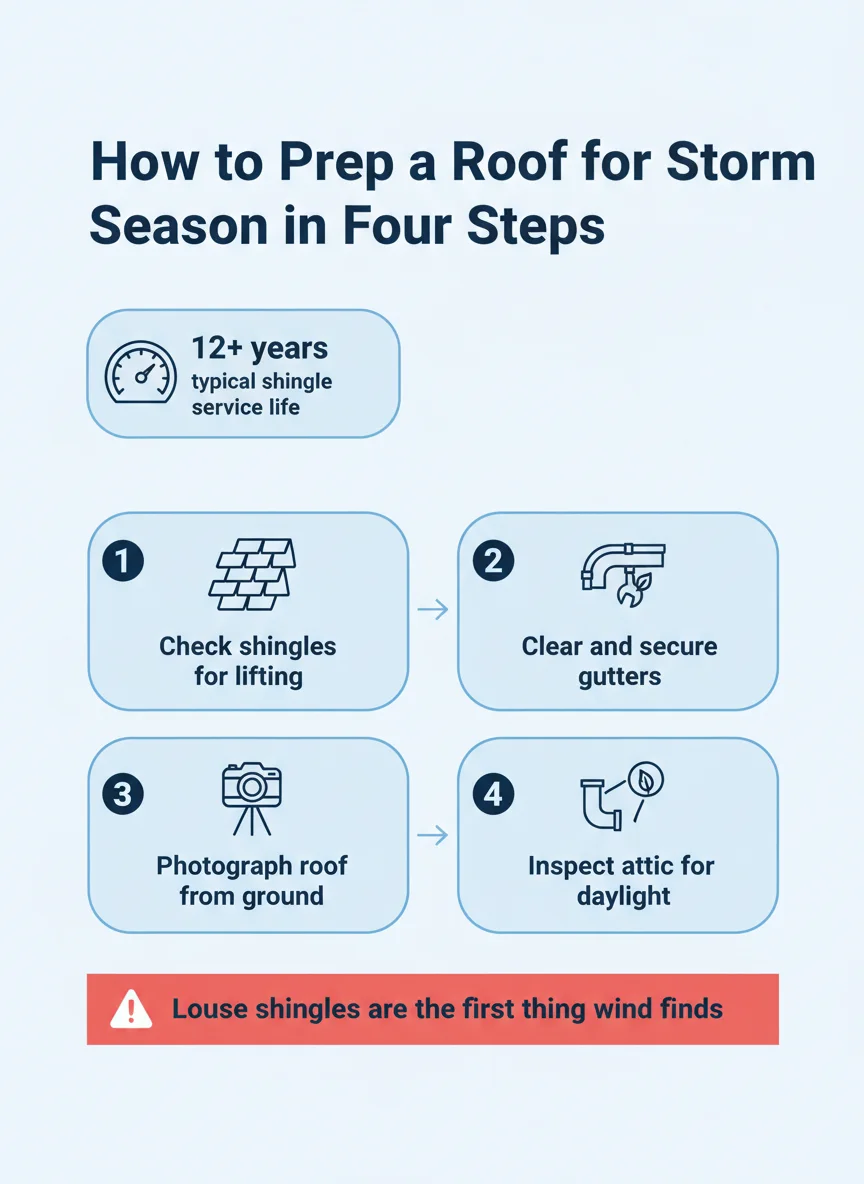
Most of this checklist can be done from the ground or with a quick look in the attic, no ladder required for the initial pass.
- Scan the roofline from the ground: Walk around the house and look for shingles that appear lifted, curled, or discolored compared to the rest of the roof.
- Clear all gutters and downspouts: Remove leaves and debris so water has a clear path off the roof and away from the foundation during heavy rain.
- Check visible flashing points: Look at chimneys, skylights, and vent pipes for gaps or separated flashing that could let wind-driven rain in.
- Trim overhanging branches: Cut back limbs that could scrape shingles in high wind or break off and land on the roof during a storm.
- Look inside the attic: Check for daylight coming through the roof deck, damp insulation, or musty smells that suggest an existing leak.
- Photograph the roof and gutters: Take dated photos from the ground on a clear day to document current condition before any storm rolls through.
- Note anything that needs a closer look: Flag areas that seem questionable so a licensed roofer can take a closer look before the season's first big storm.
What These Warning Signs Usually Mean
If You See Lifted or Missing Shingles
Lifted or missing shingles usually mean the adhesive seal has already broken down in that spot, often from age, prior wind exposure, or a manufacturing edge that never sealed fully. Left as-is, that section is the most likely place for wind to do real damage during the next storm, even a moderate one.
This doesn't always mean the whole roof needs replacing. Isolated lifted shingles can often be resealed or replaced individually if caught early, which is exactly why a pre-season check matters more than an after-storm scramble. For more on when a spot repair is enough versus when it's time to consider a full replacement, see our guide on shingle roofing repair or replace.
If You Find Moisture or Daylight in the Attic
Daylight visible through the roof deck or damp insulation in the attic means water or air is already getting through somewhere it shouldn't. That's worth addressing before storm season adds more wind-driven rain to the equation, since a small existing gap tends to get worse under storm conditions.
Musty smells or visible mold in the attic point to moisture that's been building for a while, not something a single recent rain caused. That's a sign the ventilation or a specific leak point needs attention from a professional rather than a quick patch.
What You Can Check Yourself and What Needs a Pro
Ground-level visual checks, gutter cleaning, and attic walk-throughs are all reasonable for most homeowners to handle on their own, as long as attic access is safe and the roof doesn't require climbing. Photographing your roof and gutters for a before-storm record is also something anyone can do with a phone camera and a clear day.
Getting on the roof itself, resealing lifted shingles, or repairing flashing around chimneys and vents is riskier and more technical work best left to a licensed roofer. Steep pitches, wet conditions, and the specialized fasteners and sealants involved in flashing repair all raise the odds of a homeowner making a small problem worse.
If your ground-level check turns up anything questionable, that's the right moment to call a professional rather than climbing up to investigate yourself. A trained eye can often tell the difference between cosmetic wear and an actual weak point that needs repair before the season's first real storm.
Heading Into Storm Season With Confidence
A roof that's been checked, cleared, and documented before storm season gives you a real advantage, both in how well it holds up and in how prepared you are if something does happen. None of this checklist requires major work, just a few hours of attention at the right time of year.
If your walk-through turns up lifted shingles, gutter issues, or attic moisture, Full Life Roofing Construction serves homeowners throughout Branson, Springfield, and the surrounding Ozarks and can take a closer look before the next round of storms rolls through.
Frequently asked questions
What should I check on my roof before storm season?
Start by looking at your shingles from the ground for lifting, curling, or bare spots, then check that gutters are clear and downspouts drain freely. Those two areas are where wind and heavy rain cause the most damage first.
Should I photograph my roof before storm season?
Yes, taking dated photos of your roof, gutters, and any visible damage before storm season gives you a clear before-and-after record if a storm does cause damage. Photos from the ground on a clear day are usually enough, a full inspection isn't required just to document condition.
Can wind damage a roof even without hail?
Yes, strong straight-line winds common in Missouri storms can lift and tear shingles, especially along edges and ridges, without any hail involved. Wind damage is sometimes harder to spot than hail because it doesn't leave obvious dents, just missing or displaced shingles.
How does attic ventilation relate to storm prep?
Good attic ventilation keeps moisture from building up under the roof deck, which matters because storm season often brings both heat and heavy rain in the same week. A poorly ventilated attic is more likely to develop hidden moisture problems that get worse if a storm causes even a small leak.
When is the best time to have a roof checked before storms hit?
Late winter or early spring, before the first heavy storms of the season, is the best window to catch problems while repairs are still straightforward. Waiting until storms are already forecast leaves little time to address anything a check turns up.