
Water Stains Are a Regular Call Across the Branson & Springfield Area
Homes across the Ozarks see a wide swing in weather over a single year, heavy spring rain, humid summers, and freeze-thaw cycles in winter that all put stress on a roof system. That mix of conditions is exactly what wears down flashing, seals, and shingle edges over time, and it's why ceiling stains show up so often in homes throughout this region regardless of the roof's age.
A stain rarely appears the first time water gets in. Most of the time it shows up after water has already found a path through the roof covering and worked its way across the decking or down a rafter more than once. That's the part homeowners don't always realize, by the time you see brown on the ceiling, the leak has usually been active for a while.
Why a Small Leak Can Cause a Big Stain
Water follows the path of least resistance once it's inside a roof system, which means it can travel a surprising distance from the actual opening before it ever reaches your ceiling. That's true whether the source is a damaged section of roofing, a worn seal, or trapped moisture that never had anywhere else to go.
Active Leaks at Penetrations or Damaged Sections
An active leak usually traces back to a spot where something breaks the roof surface, a vent pipe, a chimney, a valley, or a section where the covering itself has been damaged or lifted. Water gets under the covering at that point and finds its way down through the decking during rain.
These leaks tend to show up during or shortly after a heavy rain and can worsen with wind-driven water, since wind can push moisture up under edges that would otherwise shed water fine on a calm day. If you notice the stain growing during a storm, that's a strong sign you're dealing with an active leak rather than old residual moisture.
Slow Leaks at Flashing, Pipe Boots, or Valleys
A slow leak is sneakier. It's usually caused by a small crack in a pipe boot, a flashing seam that's worked loose, or a valley where two roof planes meet and shingles have worn thin. These spots let a small amount of water through with almost every rain instead of just during heavy storms.
Because the amount of water is small, slow leaks can go unnoticed for months, showing up as a faint ring on the ceiling that slowly darkens rather than a sudden wet patch. These are some of the more common leaks we trace back once we're up on the roof.
| Type | What You'll Notice | Typical Cause |
|---|---|---|
| Active leak | Wet ceiling during or right after rain | Damaged shingles or an open penetration |
| Slow leak | Faint ring that slowly darkens over weeks | Worn flashing, valley, or pipe boot |
| Attic condensation | Stain with no obvious source or pattern | Poor attic ventilation trapping moisture |
What's Actually Happening Above Your Ceiling
Between your ceiling and the roof covering sits the decking, usually plywood or OSB, plus insulation and the framing that holds it all up. Water that gets past the shingles or metal panels lands on that decking first, and if it's not stopped there, it soaks into insulation and eventually shows up as a stain on the drywall below.
That's also why a small entry point on the roof can produce a stain that looks much bigger than the actual damage. The water spreads across the decking and insulation before it ever reaches the ceiling, so the visible stain is really just the last stop on a longer path.
Step-by-step: What Happens During a Leak Inspection Visit
A typical leak inspection runs about one to three hours on site, depending on how easy the source is to find and how much of the roof needs to be checked.
- Walk the interior: We start inside near the stain, checking the attic if there is one for wet insulation, staining on the decking, or daylight coming through anywhere it shouldn't.
- Trace the path: We follow the water's likely route from the stain back up toward the roof, since the entry point is often several feet away from the stain itself.
- Inspect the roof surface: We get up on the roof to check the suspected area along with common trouble spots like valleys, flashing, and penetrations nearby.
- Confirm the source: Once we find the actual entry point, we confirm it matches the pattern of the interior damage before recommending any repair.
- Explain the fix: We walk you through what caused the leak and what it will take to fix it, whether that's a targeted repair or a larger section of the roof.
What You'll Likely Find Once We're Up There
If It's an Active Leak
When the leak is active, we're usually looking at a section of damaged, lifted, or missing shingles, or an open gap around a penetration that's letting water straight through. These repairs are typically straightforward once the source is confirmed.
If the damage is limited to one area, a targeted repair is often enough to solve the problem without touching the rest of the roof, which is one reason it pays to catch these early. Our shingle roofing crews handle these repairs as part of regular service calls.
If It's a Slow, Hidden Leak
Slow leaks tend to be trickier because the source is smaller and less obvious. Worn flashing around a chimney, a cracked pipe boot, or a valley that's lost its granules are all common culprits that don't announce themselves the way a missing shingle does.
These leaks are worth fixing as soon as they're found, since the same small crack that's letting in a trickle of water today will let in more over time as it wears further. Left alone, a slow leak eventually does the same damage as an active one, just on a longer timeline.
DIY vs Calling a Pro
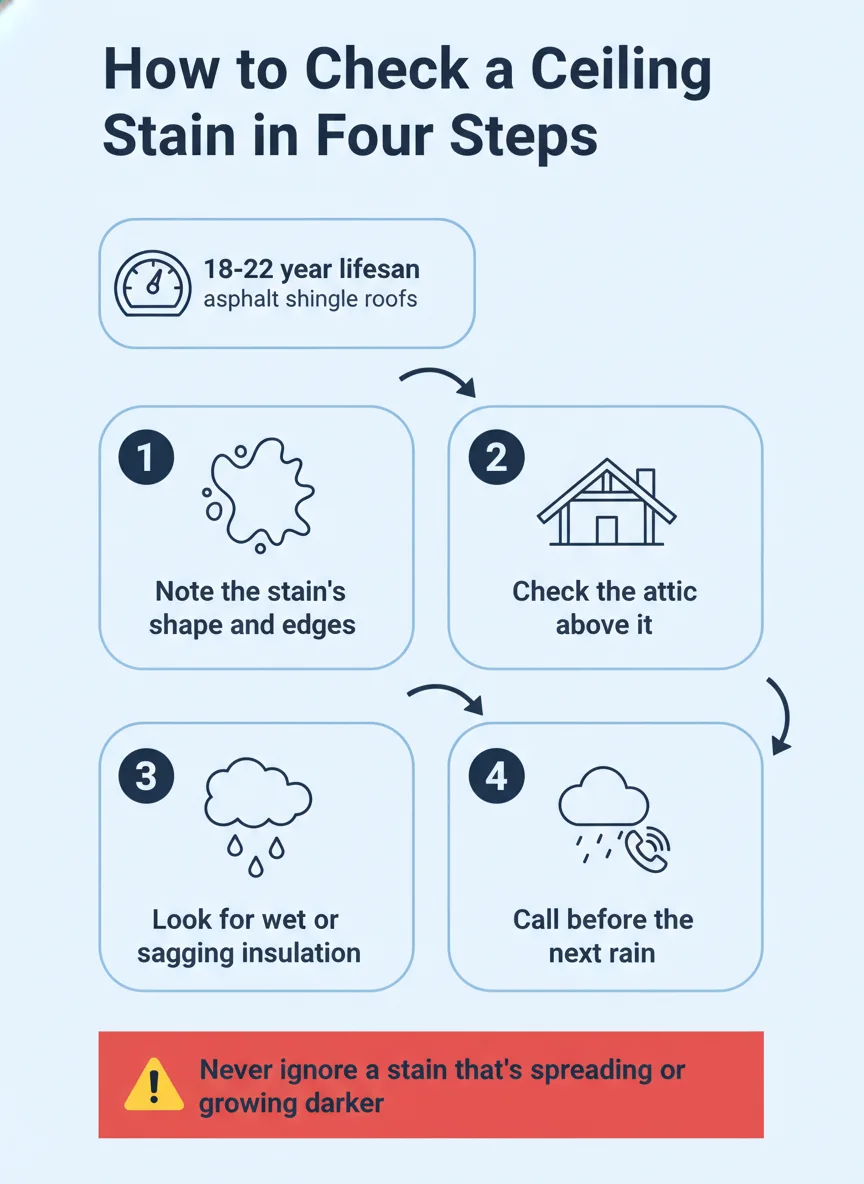
There's plenty a homeowner can safely check without getting on a ladder. Looking in the attic for wet insulation, staining on the decking, or daylight where there shouldn't be any is a good first step, along with noting the exact shape and location of the ceiling stain and whether it grows during rain.
Getting on the roof itself is a different story. Finding the actual entry point often means walking the roof surface, checking flashing and penetrations up close, and sometimes removing a shingle or two to look underneath, work that's best left to someone with the right footing, harness, and experience reading roof damage.
A licensed roofer also knows what a repair actually needs to hold long-term versus a quick patch that fails again next season. If your roof is older or the leak keeps coming back after a DIY fix, that's usually the sign it's time to bring in a pro rather than keep chasing the same stain.
Get Ahead of the Damage
A ceiling stain is your roof telling you something has already gone wrong, and the longer it's left alone, the more it tends to spread into insulation, framing, and drywall repairs that cost more than the original fix would have. Catching it early almost always means a smaller, simpler job.
If you're seeing a new stain or one that's grown since you last checked, it's worth getting eyes on the roof before it turns into a bigger project. If you're in Merriam Woods or nearby in Ozark, and you'd rather understand what's causing wind and hail damage first, our guide on storm damage covers that side of things. Full Life Roofing Construction handles these leak calls regularly across the region.
Frequently asked questions
Does a ceiling stain always mean an active leak?
Not always. Sometimes a stain is old damage from a leak that's already been fixed, or it's condensation from poor attic ventilation rather than a hole in the roof. The only way to know for sure is to check the attic and the roof surface above the stain.
Can I just paint over a water stain?
You can, but if the source hasn't been fixed the stain will usually bleed through again after the next rain. Painting over an active leak also hides the evidence a roofer needs to trace the water's path.
Why is the stain not directly under where the roof looks damaged?
Water rarely drips straight down. It tends to run along the roof decking or rafters and show up several feet from where it actually entered, which is why a visual check from the ground can be misleading.
How fast does a small leak turn into a bigger problem?
It depends on how much water is getting in and how often, but wet insulation and framing can start to develop mold and lose strength within weeks of repeated exposure. A leak that seems minor in summer can become a real issue by the next wet season.
Is a leak inspection different from a full roof inspection?
A leak inspection focuses on tracing one specific problem back to its source, usually starting at the stain and working outward. A full roof inspection looks at the entire roof system, which is a good idea afterward if your roof is getting older.