
The repair or replace question comes up more than you'd think
Across the Branson and Springfield area, shingle roofs take on years of sun exposure, wind, and seasonal temperature swings before the first sign of trouble ever shows up. When damage does appear, the question homeowners ask first is almost always the same one: is this worth fixing, or is it time for a new roof?
There's no single answer that applies to every roof, but there is a clear set of factors that tip the decision one way or the other. Age, the extent of the damage, and how the rest of the shingles are holding up together tell you more than any one symptom on its own.
Why the same damage means different things on different roofs
A patch of missing shingles on a five-year-old roof and the same patch on an eighteen-year-old roof are not the same problem, even though they look identical from the driveway. The younger roof has plenty of material life left to justify a targeted repair, while the older one is likely showing that damage because the whole surface is nearing the end of its useful life.
Roof age and material fatigue
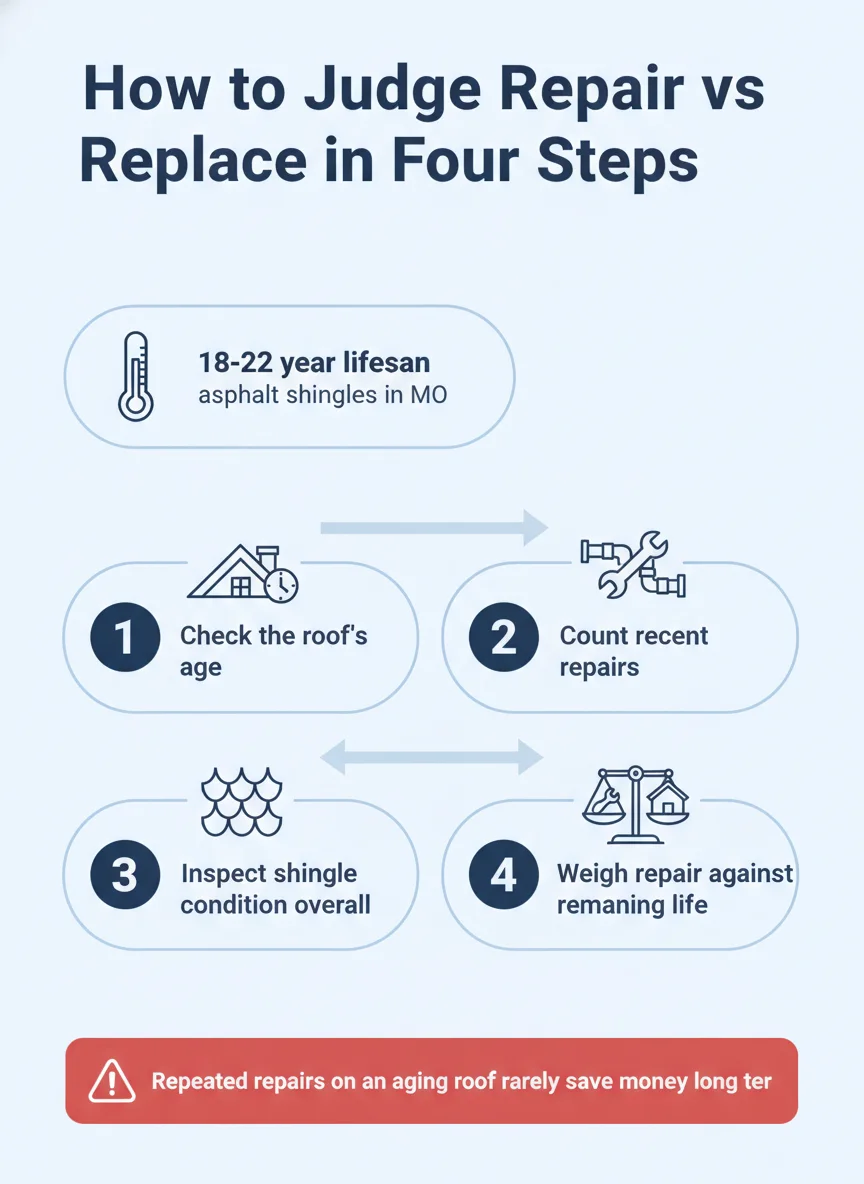
Asphalt shingles across Missouri typically last somewhere in the 18-22 year range depending on installation quality and sun exposure, and that lifespan matters directly to the repair decision. A roof well within that window with isolated damage is usually a good repair candidate, since the surrounding material is still flexible and sealing properly.
A roof at or past that age range is a different story, because the granule loss and UV breakdown happening across the whole surface means a repair in one spot doesn't address what's happening everywhere else. In that case, a repair buys you a short delay, not a real fix.
Pattern of repairs over time
One repair call in several years doesn't say much about the roof as a whole, but a second or third call in a short span is a real signal. It usually means the underlying shingles are past the point where isolated fixes hold up, and new problem spots keep showing up because the whole roof is aging out together.
If you've noticed curling or brittle shingles alongside repeat repair needs, it's worth reading Old roof, curling or bald shingles: what it usually means for a closer look at what that combination typically points to.
| Situation | Repair usually makes sense | Replacement usually makes sense |
|---|---|---|
| Roof age | Under 15 years | Approaching or past 18-20 years |
| Damage extent | Isolated to one section | Spread across multiple areas |
| Repair history | First repair call | Second or third repair in a few years |
| Shingle condition elsewhere | Still flexible, granules intact | Curling, balding, brittle |
What's actually being assessed on a shingle roof
A proper roof assessment looks past the visible damage to check the flashing around chimneys and vents, the condition of the underlayment where it's exposed, and how the shingles across the rest of the roof are holding their color and shape. Shingle Roofing work covers both full replacement and targeted repair, and the right call depends on what all of these areas show together, not just the spot that prompted the call.
Flashing points in particular deserve close attention, since they're often where leaks start even on a roof that otherwise looks fine. A damaged flashing seal can sometimes be repaired on an otherwise healthy roof, while the same issue on an aging roof might be one of several signs pointing toward full replacement.
Step-by-step: how the repair or replace decision gets made
A thorough assessment generally follows this order, whether the roof ends up getting a repair or a full replacement.
- Confirm the roof's age: Knowing how old the roof is sets the baseline for how much material life is realistically left.
- Inspect the damaged area: The specific spot that prompted the call gets checked closely to understand its cause and extent.
- Check the rest of the roof: Other sections get reviewed for granule loss, curling, or brittleness that wouldn't show from the ground.
- Review repair history: Past repair calls on the same roof are factored in to spot a pattern if one exists.
- Weigh cost against remaining life: The repair cost gets weighed against how many years of service the roof likely has left.
- Make the recommendation: A clear repair or replace recommendation is given based on everything found during the inspection.
What the damage pattern tells you before you even call
You can learn a lot about which direction you're heading just by looking at where and how the damage shows up on your roof.
Isolated damage in one area
Damage limited to one section, like a spot hit by a fallen branch or a single area with lifted shingles, is the clearest sign a repair is a reasonable option. As long as the rest of the roof looks consistent and isn't showing wear, this kind of damage is usually straightforward to address.
The key check here is making sure the damage really is isolated and not just the most visible symptom of a wider problem. A quick look at the surrounding shingles confirms whether the rest of the roof matches the healthy section or the damaged one.
Damage showing up in multiple spots
When damage or wear starts appearing in more than one area, roughly the same time, that pattern points toward the whole roof aging out together rather than one localized problem. This is common once a roof gets into its late teens in years, especially on sections that get the most direct sun.
In this situation, repairing each spot as it appears usually ends up costing more over time than addressing the roof as a whole, since new problem areas tend to keep showing up on the same timeline.
What a homeowner can check versus what needs a professional call
Walking your property after a windstorm or heavy rain to look for obviously displaced or missing shingles is something any homeowner can do safely from the ground. It's a good habit that gives you an early heads up before a small issue becomes a bigger one.
Actually getting on the roof to assess flashing, granule loss, and underlayment condition is not a DIY task, both for safety reasons and because it takes experience to tell the difference between cosmetic wear and a real structural concern. This is where a professional assessment earns its value.
If you're staring at a damaged section and not sure whether it's worth fixing or a sign of something bigger, that uncertainty itself is a good reason to get a professional opinion before deciding. Guessing wrong in either direction costs you money.
Making the repair or replace call with confidence
The right decision comes down to weighing the roof's age, the extent of the damage, and how the rest of the shingles are holding up, not just fixing whatever's visible today. A roof with plenty of life left and isolated damage deserves a repair. A roof showing wear across the board deserves an honest conversation about replacement.
If you're not sure which category your roof falls into, getting it looked at is the fastest way to find out. Full Life Roofing Construction can walk your roof, check both the damage and everything around it, and give you a straight answer either way.
Frequently asked questions
How do I know if my shingle roof needs a repair or a full replacement?
A repair usually makes sense for a roof under about 15 years old with isolated damage in one area, while a full replacement makes more sense once the roof is older and showing wear across multiple sections. The pattern of the damage matters as much as the age of the roof.
Is it ever worth repairing an old roof instead of replacing it?
It can be, if the roof is otherwise in decent shape and the damage is limited to a small, specific area like a flashing point or a section hit by falling debris. But if you're calling for the second or third repair in a couple years, that pattern usually means replacement will save money over time.
Does one repair mean my whole roof is failing?
Not necessarily, since a single repair for a localized issue like a damaged flashing seal or a few displaced shingles doesn't mean the rest of the roof is compromised. It's when repairs start happening in different spots across the roof that it points to a system nearing the end of its life.
What happens if I keep repairing instead of replacing?
Repeated repairs on an aging roof address the visible symptom but not the underlying material fatigue happening across the whole surface. Eventually you're paying for repairs on a roof that's going to need full replacement anyway, without ever getting ahead of the underlying problem.
Can a roofer tell me which option makes more sense for my house?
Yes, a proper inspection looks at the roof's age, the extent of the damage, and how the rest of the shingles are holding up before recommending repair or replacement. That assessment is more reliable than guessing based on one visible problem area alone.