
Why This Question Matters for Missouri Homeowners
Every roof in the Branson and Springfield area eventually crosses a line where a repair stops being the smart move. The tricky part is that the line doesn't announce itself with one dramatic failure. It shows up as a pattern: a leak here, a few curling shingles there, a repair call that didn't quite fix things the first time. Homeowners who catch that pattern early save themselves from throwing money at a roof that's already decided it's done.
Missouri's mix of hot, humid summers and freeze-thaw winters is hard on roofing materials. Shingles bake and then contract, seams expand and contract with temperature swings, and moisture works its way into any small gap that opens up. A roof installed with quality materials still ages on a predictable curve, and knowing where your roof sits on that curve is the first step to deciding whether to call for a patch or plan for a full Shingle Roofing replacement.
What Actually Wears a Roof Out
A roof doesn't fail all at once. It fails in layers, starting with the surface granules that protect the asphalt underneath from UV light, then moving to the mat itself, then to the underlayment, and finally to the wood decking. Each layer buys you time, and a roofer's job during an inspection is figuring out how many of those layers are still intact.
Sun and Heat Damage Over Time
Years of direct sun bake the oils out of asphalt shingles, making them brittle. Brittle shingles crack instead of flexing when the wind catches an edge, and once a shingle cracks it stops shedding water the way it's supposed to. This kind of wear tends to show up first on south and west-facing slopes, which take the most direct sun exposure through the day.
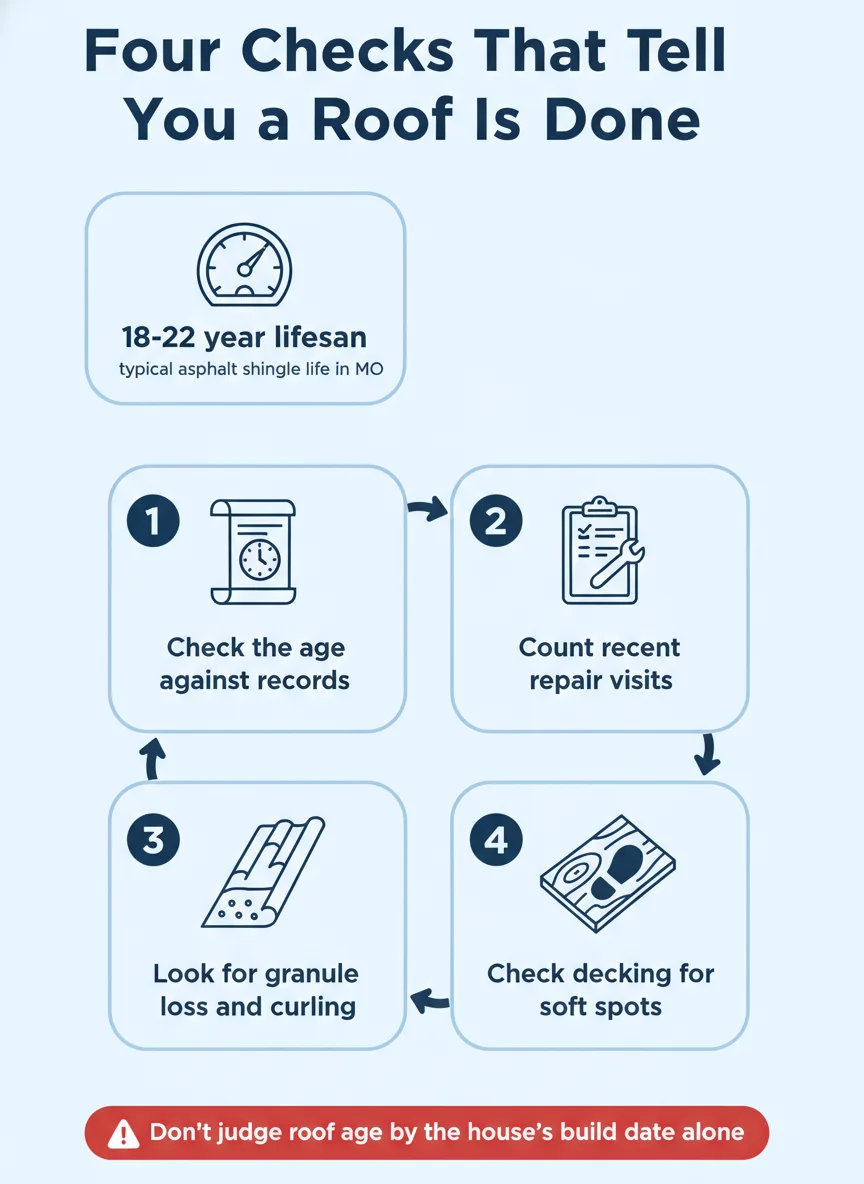
Granule loss is the visible sign of this process. A few granules in the gutter after a big wind is normal. Bald patches where you can see the black asphalt mat underneath, especially spread across multiple shingles, means the protective layer is gone in that spot and the shingle's clock is running out fast.
Water and Freeze-Thaw Cycles
Missouri winters bring repeated freeze and thaw cycles, and any water that's found its way under a shingle or into a seam expands when it freezes. That expansion widens small gaps into bigger ones, which is why a roof that seemed fine in fall sometimes develops new leaks by spring. It's also why flashing around chimneys, vents, and skylights tends to fail in more than one place at once rather than just the one spot you noticed first.
Soft decking is the end result of sustained moisture intrusion. Once water reaches the plywood or OSB sheathing under the shingles, it can rot the wood from the inside, and a soft or spongy spot underfoot during an inspection is one of the clearest signs that a repair alone won't hold.
| Sign | Usually a Repair | Usually a Replacement |
|---|---|---|
| Granule loss | Small bald spot on one shingle | Bald patches across multiple shingles or slopes |
| Leaks | One leak traced to one point | Repeat leaks in different spots over time |
| Flashing | One failed seam around a vent | Multiple failed flashing points across the roof |
| Decking | Firm underfoot everywhere | Soft or spongy in more than one area |
The Parts of the Roof a Roofer Checks
A thorough evaluation covers more than what's visible from the ground. Roofers check the shingle field for curling and granule loss, the flashing around every penetration (chimneys, vents, skylights), the ridge and valleys where water concentrates, and the decking itself wherever it's accessible, usually from the attic side.
They also look at how many layers of roofing are already on the house. A roof with one prior layover has less room to maneuver, since many codes limit roofs to two layers total, and a layover also hides the condition of the original decking from view until the old shingles come off.
Step-by-Step: How to Evaluate Whether Your Roof Is Past Repair
You don't need to climb on the roof yourself to get a sense of where things stand. These steps are what a homeowner can reasonably check before calling in a professional opinion.
- Find the install date: Check your paperwork or ask the previous owner when the roof was last replaced, not when the house was built.
- Count recent repairs: If you've called someone out two or more times in the last couple of years for different leaks, that's a pattern worth paying attention to.
- Walk the perimeter: Look up from the ground for curling edges, missing shingles, or bald patches visible from the yard or driveway.
- Check the attic: Look for daylight coming through the decking, water stains on the underside of the sheathing, or a musty smell.
- Check the gutters: A heavy buildup of granules in the gutters after a normal wind, not a major storm, suggests accelerated shingle wear.
- Get an eyes-on opinion: Have a roofer walk the roof and check the decking firmness in a few spots, not just the areas with visible problems.
What the Findings Usually Mean
If the problems are isolated, the fix is usually isolated too. One cracked flashing seam, a handful of shingles blown loose in a windstorm, or a single soft spot traced to a specific leak source can often be addressed with a targeted repair that gets years more life out of the rest of the roof.
When the Pattern Points to Replacement
When the wear is spread across the roof rather than concentrated in one spot, that's the signal that the whole system is aging out together. Widespread granule loss, curling shingles across more than one slope, and decking that feels soft in multiple places all point the same direction: a repair would just be treating one symptom while the rest of the roof keeps failing around it.
The Role of Age in the Decision
Asphalt shingles in Missouri's climate typically run in the 18 to 22 year range industry-wide before they've used up most of their protective life, though sun exposure, ventilation, and installation quality all shift that number. A roof in that age range with any of the warning signs above is usually a better candidate for replacement than repair, since the materials underneath have likely aged at a similar pace even where they look fine on the surface.
What You Can Check Yourself vs What Needs a Pro
Homeowners can safely do a lot of the early legwork. Checking paperwork for the install date, walking the yard to look up at the roofline, peeking in the attic for stains or daylight, and noticing gutter granule buildup are all things you can do without a ladder or any special tools.
Getting on the roof itself, checking decking firmness in multiple spots, and evaluating flashing condition up close are jobs for a licensed roofer. Walking on an aging roof carries real risk of causing additional damage or injury, and spotting soft decking from the attic side requires knowing what normal sheathing looks and sounds like compared to compromised wood.
A professional evaluation also carries more weight if you're weighing a repair against a replacement for budgeting purposes, since a roofer can tell you honestly whether a repair is a real long-term fix or a short-term patch on a roof that's already decided to retire.
Making the Call
The signs that separate a repairable roof from one that's past its service life are consistent: how old the roofing system actually is, how many places are showing wear rather than just one, and whether the decking underneath is still sound. Catching the pattern early, rather than waiting for a ceiling stain to force the question, gives you more time to plan and more options once you've made the decision.
If you're trying to figure out where your own roof stands, or you're comparing this question against related issues like missing shingles after a windstorm, a roof evaluated by a roofer serving Branson and the surrounding towns can tell you plainly whether you're looking at a repair or a replacement. Full Life Roofing Construction walks homeowners through that decision without the sales pressure.
Frequently asked questions
How do I know if my roof needs to be replaced instead of repaired?
You're likely past repair if you've had more than one or two leak calls in the past couple of years, if granule loss is widespread rather than in one spot, or if the decking feels soft underfoot in multiple areas. A single isolated issue, like one cracked flashing seam, is usually still a repair.
Does the age of my house tell me the age of my roof?
No, and this trips up a lot of homeowners. A house built decades ago may have had the roof replaced once or twice since, so the roof's actual install date, not the home's build year, is what matters for lifespan decisions.
Can a roof with one leak still be repaired?
Often, yes. A single leak traced to one flashing point or a handful of damaged shingles is a classic repair job, especially if the rest of the roofing field is in good shape with no widespread granule loss or curling.
What happens if I keep patching an old roof instead of replacing it?
Repeated patching on a roof near the end of its life tends to cost more over time without solving the underlying problem, since the underlayment and decking keep aging even where the surface looks fixed. Eventually water finds a new path and you're back to square one.
Is a roof with one prior layover harder to repair?
Yes, a roof with a layover (a second layer of shingles installed over the first) hides more of the decking from view and limits future repair options, since many codes won't allow a third layer. That's often a sign it's time to plan for a full tear-off and replacement.