
Wind Damage Is Common Across the Branson & Springfield Area
Homes across the Branson and Springfield area sit through plenty of spring and summer wind events, and a roof doesn't have to go through a named storm to lose a few shingles. A single strong gust front moving through towns like Ozark, Nixa, or Hollister can be enough to lift tabs that were already weakened by sun and age, even on a roof that looked fine the week before.
The tricky part is that missing shingles rarely show up alone. By the time you notice a bare patch from the driveway, there's a good chance nearby shingles have broken seals too, even though they're still sitting in place. That's why a quick visual check from the ground often undersells what's actually happening up top, and it's worth getting eyes on the roof soon after a windy afternoon rather than waiting for a leak to show up inside.
Why Wind Peels Shingles Off in the First Place
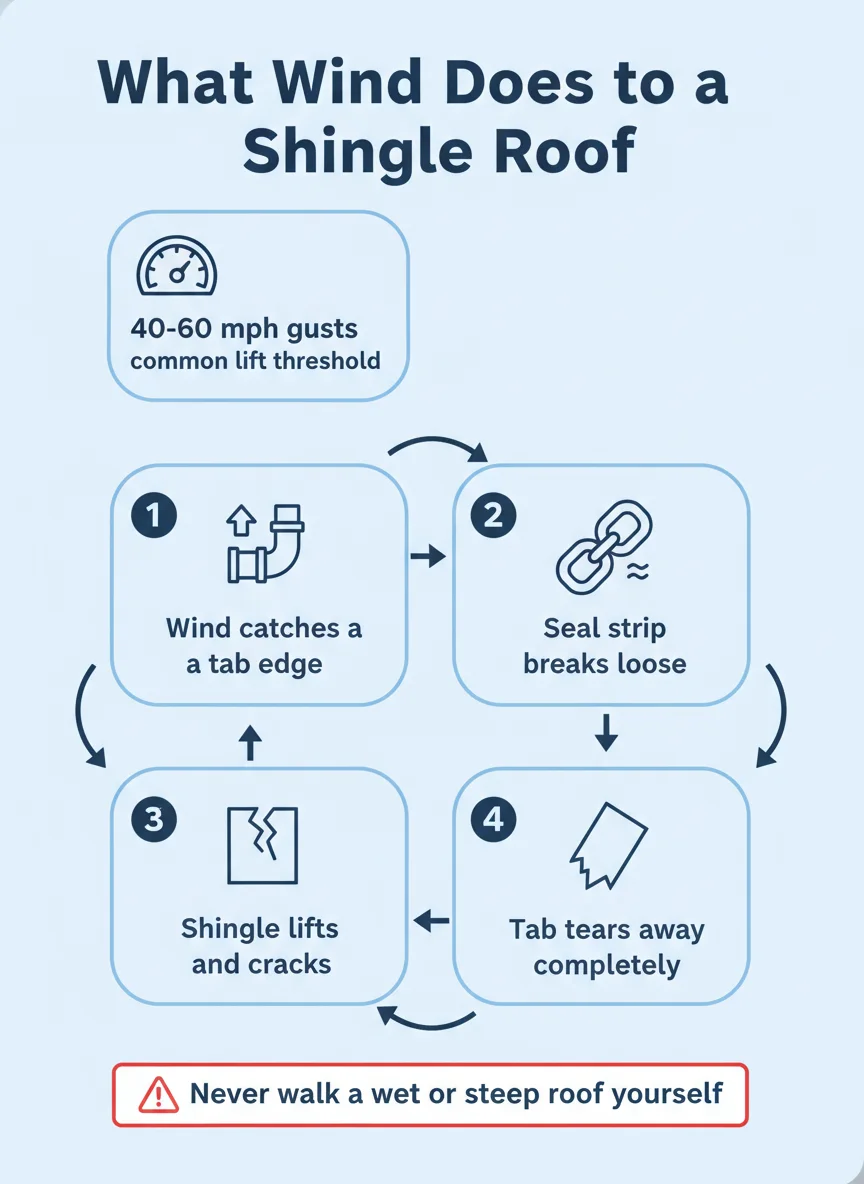
Asphalt shingles rely on a thin adhesive seal strip along the bottom edge of each row to bond to the shingle below it. That seal is what keeps wind from getting a grip. Once it's intact, a shingle resists uplift even in fairly strong gusts. Once it fails, from age, heat cycling, or a prior storm, the next good wind event has an edge to grab.
How a Seal Strip Fails Over Time
Sun and temperature swings are the main culprits. Years of expanding and contracting through hot Missouri summers and cold winters dries out the adhesive and makes the shingle mat more brittle at the edges. A roof that's twelve, fifteen, or more years old has a lot more of these weakened seals than a roof installed in the last five years, even if nothing looks visibly wrong.
Poor original installation can speed this up too. Shingles nailed too high, or without enough fasteners, don't hold the seal line as tightly and are more prone to lifting in weaker wind than they should be. That's one reason a wind event sometimes exposes a roof's age or install quality faster than anything else could.
Why a Few Missing Shingles Usually Mean More Broken Seals
When wind rips a shingle away completely, it's almost never the only one affected. The same gust that tore one tab off typically cracked or broke the seal on several shingles around it that are still physically in place. Those shingles look fine from the ground but are now loose enough to lift, flap, and let water underneath the next time it rains hard or the wind picks up again.
This is the main reason a roofer walks the whole slope instead of just replacing the obvious bare spots. Checking tab edges by hand for give, looking at granule loss patterns, and checking the surrounding courses tells us whether we're dealing with an isolated patch or a wider problem that will keep shedding shingles with the next wind event.
| Situation | Usually a Repair | Usually a Replacement |
|---|---|---|
| Roof age | Under 10 years old | 15+ years old |
| Affected area | A few shingles in one spot | Multiple areas across the roof |
| Shingle condition nearby | Still flat, granules intact | Curling, bald patches, brittle edges |
| Matching shingles available | Close match possible | Discontinued or badly faded |
What a Roofer Is Actually Looking At During an Inspection
An inspection after wind damage isn't just counting bare spots. We're checking the exposed roof deck and underlayment where shingles are missing, looking for water staining or soft spots that would mean moisture already got in. We're also checking the shingles bordering the damage for lifted tabs, cracked seal strips, and granule loss, since those are the ones most likely to fail next.
Flashing around chimneys, vents, and valleys gets checked too, since wind can loosen flashing edges at the same time it lifts shingles nearby. If the roof has gutters along the affected eave, we'll look those over as well, since torn-off shingle granules and debris often end up there after a wind event and can point to how much material came loose.
Step-by-Step: How the Repair-or-Replace Decision Gets Made
Deciding between a patch repair and a full replacement follows a fairly consistent process, and walking through it helps a homeowner understand why the recommendation lands where it does.
- Walk the full roof: We check every slope, not just the side with visible missing shingles, since wind damage is rarely confined to one spot.
- Check seal strip integrity: We lift nearby shingle tabs by hand to see if the adhesive seal is still holding or if it's already broken loose.
- Assess overall shingle age: Granule loss, curling edges, and brittleness tell us how much life is left in the roof as a whole.
- Check for matching material: If a repair is viable, we see whether the existing shingle color and style can still be matched closely.
- Inspect the deck underneath: Any exposed decking gets checked for moisture damage before new shingles go back down.
- Give a straightforward recommendation: We explain what we found and whether a targeted repair or a full shingle roofing replacement makes more sense for the roof's condition.
What You'll Typically Find Once the Inspection Is Done
When the Damage Points to a Repair
If the roof is relatively young, the missing shingles are confined to one area, and the surrounding shingles are still sealing well, a repair is usually the right call. We'll replace the missing and compromised shingles, check the underlayment underneath for any moisture, and reseal the area so it performs like the rest of the roof.
A well-done repair on a healthy roof can hold up for years without issue, and there's no reason to replace a roof that still has a lot of service life left in it just because of a localized wind event. The goal of the inspection is to confirm that the rest of the roof genuinely supports that conclusion before we move forward.
When the Damage Points to Replacement
If the roof is older and we're finding broken seals and granule loss well beyond the obvious bare patches, a repair becomes a short-term fix at best. Patching one section of an aging roof often means dealing with a new round of lifted shingles somewhere else after the next wind event, since the rest of the roof is aging at roughly the same rate.
In those cases we'll lay out what a full replacement looks like, including material options and what the existing roof's condition tells us about how much longer it would realistically hold up if left as-is. That's a different conversation than one about hail or wind damage after a storm, but the two often come up together.
What You Can Check From the Ground vs. What Needs a Pro
There's a fair amount you can safely check without a ladder. Walk the perimeter of the house after a windstorm and look for shingle pieces in the yard, flower beds, or gutters, since that debris tells you something came loose even if you can't see the exact spot from below. Check the attic for any new daylight, staining, or damp insulation, especially after a heavy rain following the wind event.
What you shouldn't do is get on the roof to assess or patch the damage yourself. Seal strip failure isn't always visible to the eye, and a homeowner walking a roof without the right footwear or experience risks both their safety and causing more damage to shingles that are still intact but fragile.
A licensed roofer brings the right equipment to walk the roof safely, the experience to tell a localized problem from a roof-wide one, and the ability to source matching shingles when a repair is the right call. That combination is really what determines whether the fix holds for years or needs to be revisited after the next storm.
Getting the Right Call the First Time
A windstorm that leaves a few shingles missing doesn't automatically mean a new roof, but it shouldn't be ignored either. The safest move is getting someone up there to check the roof as a whole, not just the obvious damage, so the decision between repair and replacement is based on what's actually happening to the shingles rather than a guess from the driveway.
If a recent windstorm left your roof looking a little lighter than it used to, Full Life Roofing Construction can walk the roof and give you a straight answer on whether it's a repair or time for something more.
Frequently asked questions
Why did my roof lose shingles in a windstorm that wasn't even that bad?
Wind doesn't need to be severe to pull shingles loose if the seal strips underneath were already weakened by age or heat cycling. A roof with years of sun exposure can shed shingles in a moderate gust that a newer roof would shrug off.
Can I just replace the missing shingles myself?
You can patch a shingle or two if you have the matching material and know how to work the seal strips and nail pattern correctly. Getting on the roof safely and matching the existing shingle color are the bigger obstacles for most homeowners.
How do I know if it's a repair or I need a whole new roof?
It comes down to how much of the roof is affected and how old the existing shingles are. A handful of missing shingles on a roof under ten years old is usually a repair, while widespread lifting on an older roof often points toward replacement.
Will new shingles match my old roof after a repair?
A close match is usually possible if the replacement happens soon after the damage, but shingles fade with UV exposure over the years so an older roof may show some color difference. Our team will walk you through what to expect before starting the work.
Is wind damage to shingles something insurance typically covers?
Many homeowner policies cover sudden wind damage, but coverage details vary by policy and insurer. Check with your insurance company or agent about your specific policy terms before assuming what's covered.