
A Replacement Day Looks Like Chaos From the Curb
If you've never watched a full roof replacement, the first hour can look alarming. A dumpster or trailer shows up before the sun is fully up, ladders go against the house, and within minutes shingles are flying off the roof and landing with a thud below. For homeowners across the Branson and Springfield area, this is simply the fastest way to get an aging roof off and a new one on before weather turns. It's loud, it's fast, and it's organized chaos with a sequence behind it.
Understanding that sequence takes the mystery out of the day. A crew isn't just ripping material off and nailing new stuff down. Each layer gets checked, repaired if needed, and sealed before the next one goes on top. Knowing what's supposed to happen at each stage helps you spot a job done right, and it tells you what questions to ask if something looks off.
Why the Sequence Matters More Than the Material
Roofing material, whether shingle or metal, only performs as well as what's underneath it. A roof fails early far more often because of a shortcut in the layers below than because of a bad batch of material. That's why the sequence of tear-off, decking inspection, underlayment, flashing, and finally the surface material isn't just procedure, it's the entire reason a roof lasts.
Tear-off and decking
The crew strips the old roofing material down to bare decking, usually plywood or OSB sheathing. This is the point where hidden problems surface. Decking that's soft, delaminated, or stained from a long-term leak gets cut out and replaced with new sheathing before anything else goes on.
This step is also where most surprises in a project happen. A homeowner might expect a straightforward material swap and learn mid-day that a section of decking needs replacing. A good crew flags it immediately rather than covering it up, since nailing new material over rotted decking defeats the purpose of the whole job.
Underlayment and flashing
Once the deck is sound, the crew rolls out underlayment, a water-resistant barrier that protects the home if wind or ice ever gets under the surface material. In this climate, ice and water barrier typically goes along eaves and valleys where freeze-thaw cycles put the most stress on a roof.
Flashing comes next around chimneys, skylights, vents, and anywhere two roof planes meet. These are the most common leak points on any roof, so flashing gets formed and sealed carefully rather than reused from the old roof whenever possible. New flashing here is one of the quiet details that separates a roof that lasts from one that leaks within a few years.
| Stage | What Happens | Why It Matters |
|---|---|---|
| Tear-off | Old material and underlayment stripped to bare decking | Exposes hidden rot or soft spots before they're covered |
| Decking repair | Damaged sheathing cut out and replaced | New material needs a solid, flat surface to perform |
| Underlayment | Water-resistant barrier rolled across the deck | Backup protection if wind or ice gets past the surface layer |
| Flashing | Metal formed and sealed around chimneys, vents, and valleys | Prevents leaks at the points most roofs fail first |
The Roofing System Is More Than the Surface You See
What you see from the street, shingle color or metal panel seams, is the last layer applied and the one everyone judges the job on. But a roof is a system of layers working together: decking, underlayment, flashing, the surface material, and ridge venting at the top. Each layer has one job, and skipping or rushing any one of them shortens the life of the whole roof regardless of how good the top layer looks.
Ridge venting at the peak of the roof allows heat and moisture to escape the attic space, which matters in a region that sees both hot summers and cold winters. A roof installed without attention to ventilation can shorten the life of the material above it even if every other layer was installed correctly.
Step-by-step: What Happens From Start to Finish
Here's the general order a residential replacement follows once the crew arrives and the dumpster or trailer is staged in the driveway or yard.
- Setup and protection: Tarps go over landscaping, AC units, and anything near the house that could be hit by falling debris or dropped tools.
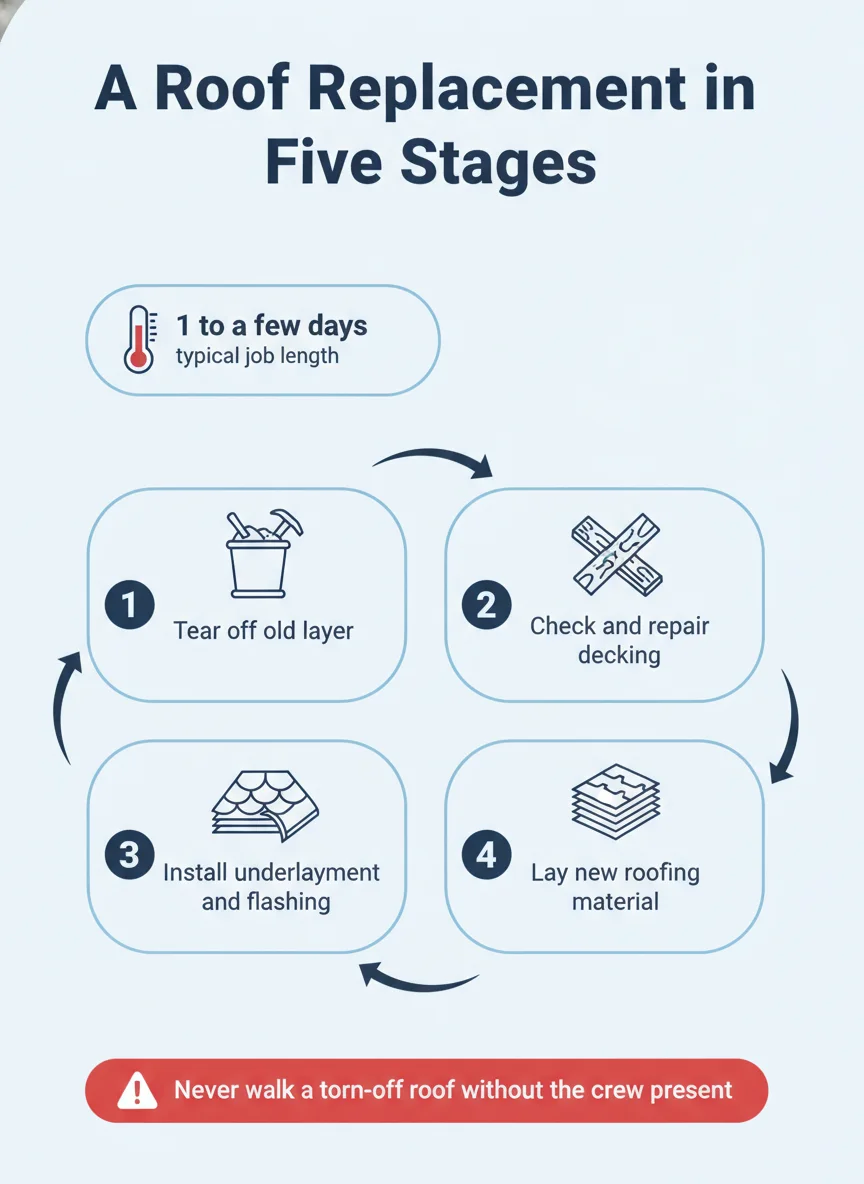
- Tear-off: Old shingles or panels, underlayment, and flashing are stripped off down to the bare decking in sections.
- Decking inspection: Crews check every sheet of decking for soft spots or rot and replace any damaged sections before moving forward.
- Underlayment and ice barrier: A water-resistant layer goes down across the whole deck, with extra protection along eaves and valleys.
- Flashing and drip edge: New metal flashing is formed and sealed around chimneys, vents, and skylights, and drip edge is installed along the roof's perimeter.
- Surface material installation: Shingles or metal panels go on in rows from the bottom up, finishing with ridge cap at the peak.
- Cleanup and magnet sweep: Debris is loaded into the dumpster, and the yard and driveway get swept with a magnetic roller to collect stray nails.
What You'll Notice During the Day
Most homeowners describe the day as louder than expected but shorter than expected. Nail guns run in bursts for hours at a time, and the thump of material being thrown into a dumpster is near-constant during tear-off. By midday on a straightforward job, the roof is usually already back to bare decking and underlayment is going down.
Inside the house
Vibration from nailing can rattle picture frames, dust off ceiling fixtures, and occasionally knock items off shelves in the attic or upper floors. It's worth taking down wall art and clearing anything breakable from attic shelving the night before. Pets tend to find the noise stressful, so a quiet back room or a day at a friend's house keeps them calmer.
Power and water usually aren't affected, and most households can work from home through the process if the noise is tolerable. Satellite dishes or solar attachments mounted to the roof may need to be temporarily removed and reset, which is worth asking about ahead of time if you have either.
Outside the house
Vehicles should be moved out of the driveway so the dumpster or trailer has clear access and so falling debris doesn't land on a car. Gardens and flower beds directly below the eaves are the most exposed areas and benefit from a tarp even if the crew is careful. Expect some foot traffic across the yard and extra noise from compressors and generators running through the day.
What You Should Handle vs. What Needs a Licensed Crew
Homeowner prep is limited to what's on the ground, not the roof itself. Moving vehicles, clearing items from attic shelves, taking down wall art, and keeping pets and kids away from the work zone are all reasonable tasks for a homeowner to handle before the crew arrives.
Everything on the roof itself, tear-off, decking replacement, underlayment, flashing, and material installation, needs a trained crew working at height with the right fall protection and tools. This isn't a job where a partial DIY effort saves meaningful money, since a single missed flashing detail or an improperly nailed course of material can undo the protection of everything installed correctly around it.
If you're weighing whether your roof needs a full replacement or just a targeted fix, it helps to read up on the difference beforehand. This guide on repair vs. replace walks through the signs that point toward one or the other before you book a crew.
Knowing What to Expect Makes the Day Easier
A roof replacement is a big, loud, one-day disruption, but it follows a predictable sequence every time: tear off the old, check the deck, protect it with underlayment and flashing, and lay the new material in order from eave to ridge. Homeowners in Ozark and across the region can expect the same general process regardless of whether the home is getting shingle or metal.
Knowing the stages ahead of time turns a stressful day into a manageable one, and it gives you the right questions to ask during the final walk-through. Full Life Roofing Construction walks homeowners through this process before the crew ever shows up.
Frequently asked questions
How long does a roof replacement take in one day?
Most single-family homes in the region are torn off, decked, and covered in new material within a single work day, weather permitting. Larger or steeper roofs, or ones needing deck repair, can stretch into a second or third day.
Do I need to be home during the replacement?
You don't have to be home, but someone should be reachable by phone in case the crew finds decking damage or has a question about material placement. Many homeowners go to work and come back to a finished roof.
Will the noise and vibration damage anything inside my house?
Tear-off and nailing do cause vibration, which is why it helps to take pictures and mirrors off the walls and move anything fragile off shelves beforehand. The vibration itself is normal and doesn't harm a structurally sound house.
What happens to the old shingles and nails?
Everything torn off goes straight into a dumpster or trailer staged in the driveway or yard, and a magnetic sweep of the lawn and driveway happens at the end of the job to pick up stray nails. Ask your contractor how they handle disposal before the job starts.
How do I know the new roof was installed correctly?
A final walk-through should cover flashing points, ridge lines, and valleys, with your contractor pointing out what was done and why. A roof that's installed to code and manufacturer spec should look uniform with no exposed nail heads or lifted edges.