
Why This Decision Matters More in Missouri
When it's time for a new roof, homeowners across the Branson and Springfield area often get quoted two different approaches: install new shingles directly over the old layer, or strip the roof down to bare decking first. The layover looks like the budget-friendly option on paper, and sometimes it is a reasonable call. But in a climate that swings from humid summers to freezing, ice-prone winters, what's happening underneath your shingles matters just as much as what's on top.
A roof that looks fine from the ground can be hiding a deck that's gone soft, flashing that's rusted through, or ventilation that's been undersized for years. None of that gets fixed by covering it with another layer of shingles. It just gets covered up, which is exactly why most roofing professionals lean toward a full tear-off whenever the roof's condition and your budget allow for it.
What Each Approach Actually Does to Your Roof
A layover is fast: crews strip the ridge and ragged edges, lay new starter strips, and shingle right over what's already there. A tear-off is slower and dirtier: every old shingle, every nail, and the old underlayment comes off down to bare wood before anything new goes on. The difference isn't just labor time, it's what each method lets a crew see and fix.
What a Layover Hides
Once new shingles go over the old layer, nobody can see the decking underneath until the next full roof job, which could be a decade or two away. Soft spots, delaminating plywood, and minor leaks that were starting to stain the sheathing all get buried. The flashing around chimneys, vents, and skylights usually doesn't get replaced either, since it's harder to access once shingles are layered on top of the old flashing.
Ventilation is another thing a layover tends to leave alone. If the attic wasn't venting properly under the old roof, it still won't be venting properly under the new shingles, since the vents and baffles are whatever was already installed. That matters for shingle lifespan and for moisture buildup in the attic over a Missouri winter.
What a Tear-Off Reveals
Pulling every layer down to the deck gives a roofing crew a clear look at the plywood or OSB sheathing, the flashing, and the vents all at once. Any soft or water-damaged decking gets cut out and replaced on the spot instead of getting shingled over and forgotten. It's the only way to confirm the deck itself is sound before a new 20-plus year roof system goes on top of it.
A tear-off also lets a crew install new underlayment across the whole roof, which matters for ice and water protection along eaves and valleys. For homes dealing with curling or bald shingles from an aging roof, a tear-off is usually the point where those underlying problems finally get addressed instead of layered over again.
| Factor | Roof-Over (Layover) | Full Tear-Off |
|---|---|---|
| Upfront labor and disposal cost | Lower | Higher |
| Decking visible for repair | No | Yes |
| Added roof weight | Yes, second layer | No, single layer |
| Typical manufacturer warranty | Often reduced | Full terms usually apply |
What's Actually Under Your Shingles
Underneath every shingle layer sits the decking, usually plywood or OSB board nailed to the roof trusses, then a layer of underlayment that acts as a water barrier, then the shingles themselves. Flashing, thin metal strips around chimneys, vents, and roof valleys, directs water away from the seams where two roof planes meet or where something penetrates the roof surface.
Each of those components has its own lifespan and its own failure points. Decking can rot from long-term moisture exposure. Underlayment degrades with age and sun exposure. Flashing rusts or pulls loose over time. A tear-off is the only moment in a roof's life when all three get a direct inspection at once, which is part of why it tends to be the safer long-term bet even though it costs more upfront.
Step-by-Step: How a Full Tear-Off Gets Done
A full tear-off follows a fairly consistent sequence regardless of which roofing material is going back on. Here's the general order a crew works through on a typical residential job.
- Protect the property: Tarps and plywood go down around landscaping, windows, and driveways to catch falling debris before removal starts.
- Strip old shingles: Crews remove every layer of shingles, old underlayment, and exposed nails down to the bare decking.
- Inspect the deck: Each section of decking gets checked for soft spots, delamination, or water staining, and damaged sections are cut out.
- Replace damaged decking: New plywood or OSB goes in anywhere the old decking failed inspection, matched to the existing thickness.
- Install new flashing: Flashing around chimneys, vents, and valleys is replaced or resealed before any new underlayment goes down.
- Lay new underlayment: A full layer of new underlayment covers the deck for water protection before shingles or metal panels go on.
- Install the new roof covering: Shingles, metal, or another roofing material is installed per manufacturer spec, finishing with ridge caps and trim.
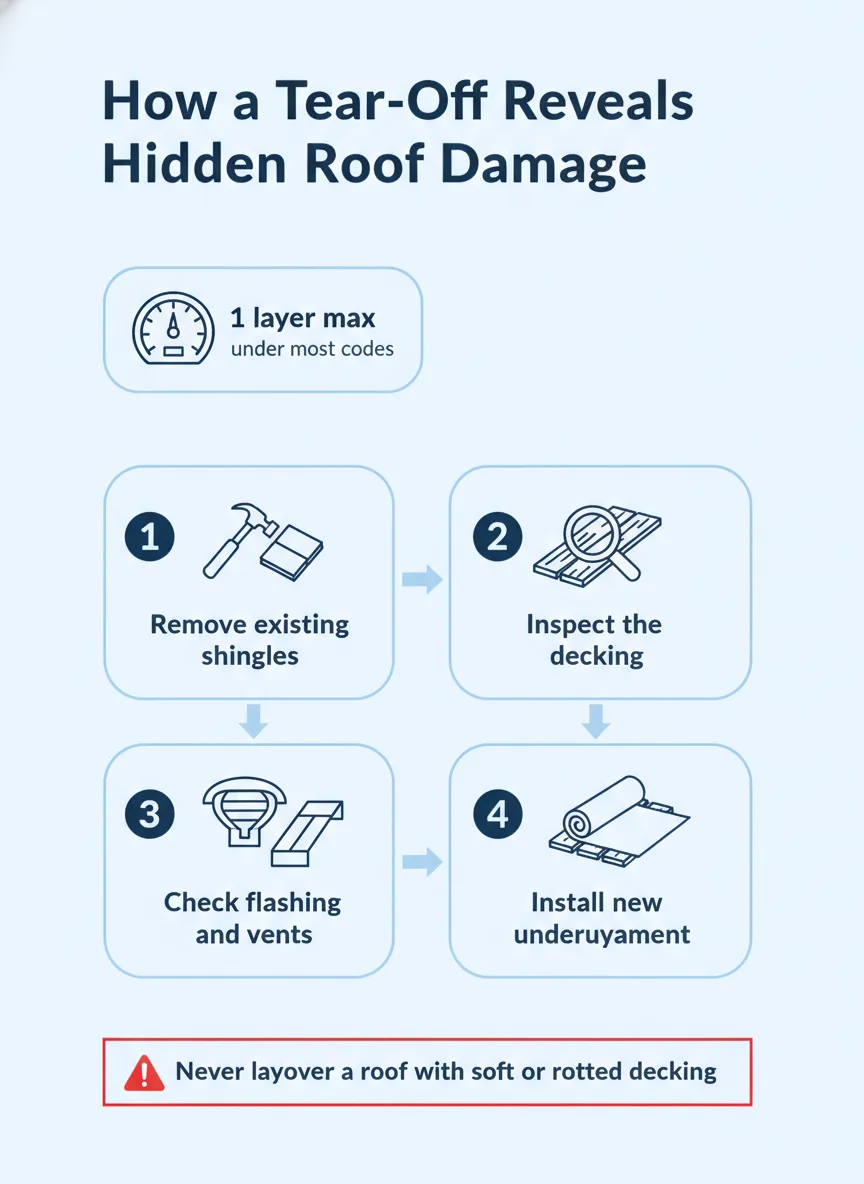
What a Tear-Off Usually Uncovers
Decking and Structural Issues
The most common surprise during a tear-off is soft or rotted decking, usually found near valleys, chimneys, or wherever a previous leak went unaddressed for a long stretch. This is often tied to the same issues behind a roof leak or ceiling stain a homeowner noticed months or years earlier. Replacing bad decking during the tear-off is far cheaper and simpler than discovering it later through a collapsed section or a new leak.
Less dramatic but still common: nail pops, uneven sheathing seams, or decking that was never properly fastened to the trusses in an older home. None of these show up on a surface inspection, only once the shingles and underlayment are stripped away.
Ventilation and Flashing Gaps
Tear-offs also expose ventilation problems, like undersized ridge vents or soffit vents that were painted shut or blocked by insulation over the years. Fixing attic airflow during a tear-off protects the new shingles from premature aging and helps prevent the kind of moisture buildup that leads to ice dams in winter.
Flashing gaps around chimneys and vent pipes are another frequent find, especially on roofs that have had one or more layovers in the past. Old flashing that's been buried under multiple shingle layers is often rusted, bent, or sealed with failing caulk instead of properly integrated, something a chimney or vent flashing issue check during a tear-off catches before it becomes a leak point.
What Homeowners Can Evaluate vs What Needs a Pro
Homeowners can do some of their own groundwork before calling a roofer. Checking the attic for daylight coming through the decking, water stains on the rafters, or a musty smell can flag problems worth mentioning up front. Counting how many shingle layers are currently on the roof, if that's known from past work, also helps narrow down whether a layover is even an option under local code.
What homeowners generally can't evaluate safely or accurately is the structural condition of the decking itself, or whether the flashing and ventilation are performing the way they should. That requires walking the roof and sometimes probing suspect areas, which is a job for a licensed roofer with the right safety equipment and experience reading what they're looking at.
The decision between a layover and a tear-off should ultimately come from that kind of hands-on inspection rather than a guess based on the roof's age or appearance from the ground. A roofer who walks the roof and checks the attic can tell you honestly which option fits your home, rather than defaulting to whichever is faster to quote.
Making the Right Call for Your Roof
A layover isn't automatically the wrong choice. On a roof with a single existing layer, sound decking, and good ventilation, it can be a reasonable way to extend a budget, especially if the home is a short-term hold. But on any roof with unknown decking condition, multiple existing layers, or a history of leaks, a tear-off is the only way to know what you're actually building a new roof on top of.
If you're weighing shingle roofing or metal roofing for your next roof and aren't sure which route makes sense for your home, Full Life Roofing Construction can walk the roof with you and lay out what each option would involve before any work starts.
Frequently asked questions
Is it cheaper to put a new roof over the old one?
A layover generally costs less upfront because it skips the labor and disposal of removing the old shingles. But it can cost more over time if it hides deck rot or shortens the life of the new layer, so the cheaper bid isn't always the better value.
Can you put a second layer of shingles on a roof?
Many local building codes allow a maximum of two layers of shingles total, meaning a roof with one existing layer can sometimes get a layover, but a roof with two layers already needs a full tear-off. Your roofer can confirm what your home currently has and what your local code allows.
Does a roof-over void the manufacturer warranty?
It depends on the manufacturer and the specific warranty terms, but many manufacturer warranties are reduced or limited when shingles are installed over an existing layer instead of a clean deck. Ask to see the warranty language before deciding which route to take.
How do you know if a roof needs a tear-off instead of a layover?
A roof needs a tear-off when there's already more than one layer of shingles, when the decking is soft or showing signs of rot, or when there's visible sagging, moisture damage, or flashing that needs to be replaced rather than worked around. A visual inspection from the attic side and the roof surface usually tells the story.
Does a layover add weight to the house?
Yes, a second layer of shingles adds measurable weight to the roof structure, and older homes or those with marginal framing can be more sensitive to that added load. A roofer can evaluate whether your structure is a good candidate before recommending a layover.