
Why metal roofing is showing up more in the Ozarks
Drive through Branson, Ozark, or Springfield and you'll spot more metal roofs than you would have ten years ago. Part of that is style, the clean lines read well on both cabins and newer builds around the lake. Part of it is longevity. A well-installed metal roof can run decades longer than a standard shingle roof, and in a region where winters bring ice and summers bring heavy sun, that durability matters.
Metal isn't the right fit for every house or every budget, and it isn't automatically better than shingles, it's a different set of trade-offs. This guide walks through the two main panel types homeowners ask about, how each one actually performs in Missouri weather, and what to expect if you're weighing metal against shingle roofing for your next project.
What's the difference between standing seam and screw-down metal panels?
Standing seam panels interlock along raised seams and are fastened with hidden clips underneath, so no screw heads are ever exposed to the weather. Screw-down (exposed-fastener) panels are simpler, flatter panels fastened directly through the face with exposed screws and rubber washers. Both are real roofing systems used across the country, but they age differently, and knowing which one you're looking at changes what maintenance to expect down the road.
Standing seam: fewer penetrations, longer service life
Because standing seam panels have no exposed fasteners, there's nothing on the roof surface that can work loose, back out, or wear through its washer over the years. The panels are also designed to expand and contract with temperature swings without stressing the fastening points, which matters in Missouri where you'll see both hard freezes and 90-plus degree days in the same year. This is the system most commonly chosen for a long-term, low-maintenance install.
The tradeoff is cost. Standing seam panels and their concealed-clip installation take more labor and material than exposed-fastener systems, so they sit at the higher end of roofing options. For homeowners planning to stay in a house for decades, or who want to minimize future maintenance calls, that upfront cost is often the whole point of choosing metal in the first place.
Screw-down panels: lower cost, more upkeep over time
Exposed-fastener panels are a common choice on outbuildings, barns, porches, and budget-conscious residential projects. They install faster and cost less than standing seam, which makes them an accessible way to get metal's durability and look without the full standing seam price tag.
The catch is that the exposed screws and their rubber washers do wear out over the life of the roof, and at some point they'll need to be checked and occasionally replaced to keep the roof watertight. That's not a flaw, it's just part of owning this system, similar to how a shingle roof needs periodic flashing checks. Homeowners who go this route should plan on that maintenance rather than treating the roof as fully hands-off.
| Factor | Standing Seam | Screw-Down |
|---|---|---|
| Fasteners | Hidden clips, none exposed | Exposed screws through the panel face |
| Upfront cost | Higher material and labor cost | Lower material and labor cost |
| Long-term upkeep | Minimal, no fasteners to service | Periodic fastener checks recommended |
| Common use | Full home re-roofs, long-term ownership | Outbuildings, budget projects, additions |
What a metal roof system is actually made of
A metal roof isn't just the visible panel, it's a full system layered over the deck. Underlayment goes down first to act as a water barrier beneath the metal, the same as it would under shingles. The panels themselves come in a range of gauges (thicknesses) and finishes, with coatings that affect both color retention and how much heat the roof reflects. Trim, flashing, and closures seal the edges, ridges, and any penetrations like vents or chimneys.
That layered approach is why installation quality matters as much as the panel choice. A premium standing seam panel installed with poor flashing work will leak just like any other roof installed badly, and a basic screw-down system installed carefully by an experienced crew can perform well for years. The panel is only part of the equation.
Step-by-step: how a metal roof install typically goes
Every crew has its own sequence, but a standard residential metal roof install follows a predictable path from tear-off to final trim.
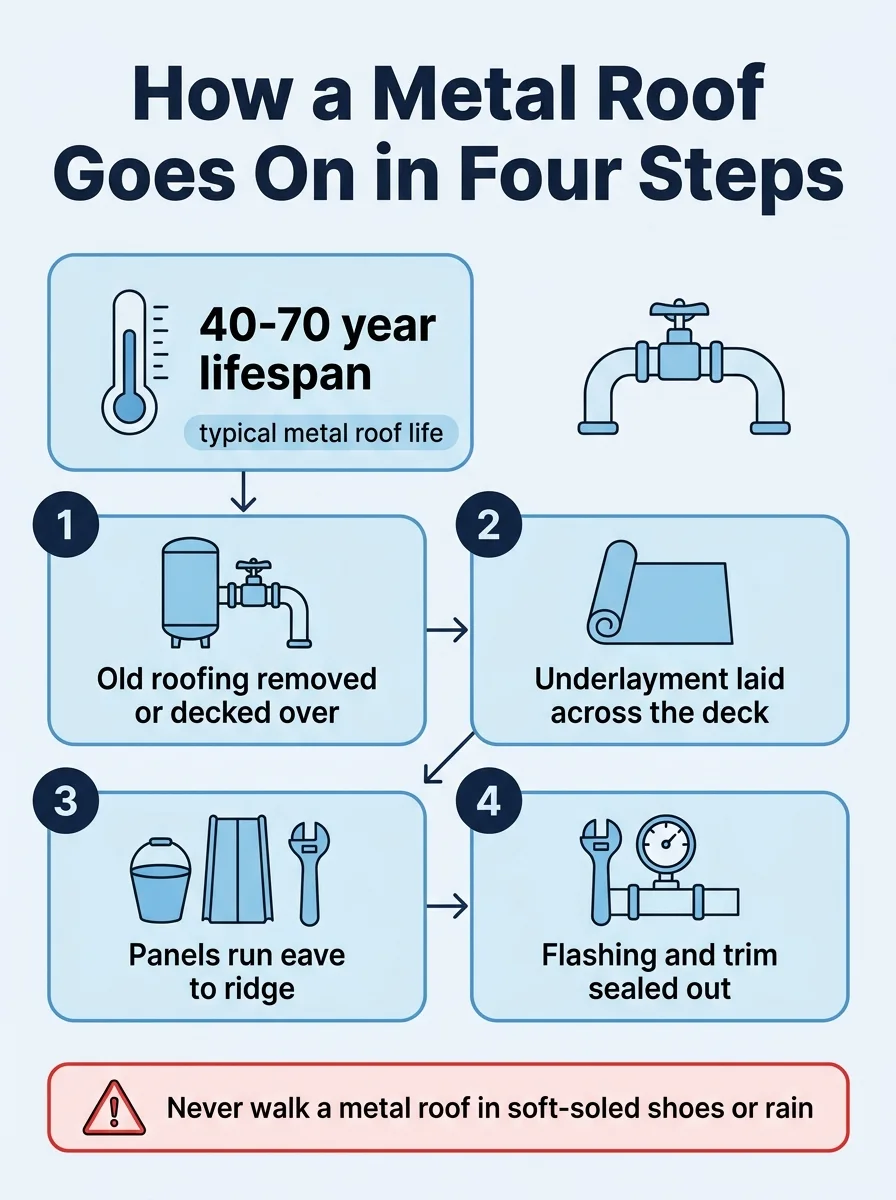
- Remove or deck over: The old roofing is removed down to the deck, or in some cases the deck is overlaid, depending on the condition underneath.
- Inspect and repair decking: Any soft, rotted, or damaged decking is replaced before anything else goes down.
- Lay underlayment: A water-resistant underlayment covers the full deck as the roof's backup barrier.
- Run panels: Panels are installed from eave to ridge, either clipped (standing seam) or fastened directly (screw-down).
- Install flashing and trim: Ridge caps, valleys, and penetrations get flashed and sealed to close out the system.
- Final walk and cleanup: The crew checks seams and fasteners and clears the site of debris and old material.
How does a metal roof actually hold up over time?
A well-installed metal roof ages slowly compared to asphalt. The biggest visible changes over the decades are usually cosmetic, slight color fading depending on the coating, and on screw-down systems, the eventual need to check or replace fastener washers. Structurally, panels themselves rarely fail outright.
Hail, wind, and heavy rain
Metal sheds wind-driven rain well because of its interlocking or overlapped seams, and it holds up to high wind loads better than many lighter materials. Hail is the question homeowners ask about most, and the honest answer is that metal rarely fails from hail impact, though it can dent, particularly on thinner panels or with very large hailstones. Some metal products carry an impact rating worth discussing if hail is a regular concern in your part of Missouri.
Heavy, sustained rain is where metal roofing shines. The seams and slope design move water off the roof quickly, and there are no shingle tabs to lift or granules to wash away over time. That's one reason you'll see it on homes near the lake where runoff and drainage are a bigger daily concern.
Heat, sun, and winter freeze-thaw
Reflective coatings on metal panels bounce back a meaningful amount of solar heat rather than absorbing it, which can take some pressure off a home's cooling system during Ozark summers. In winter, metal sheds snow and ice faster than shingles because there's less surface friction, though that same slickness means walking the roof requires extra caution in cold weather.
Temperature swings between a hot afternoon and a cold night cause metal to expand and contract, and that's exactly what the panel fastening systems, especially standing seam's floating clips, are engineered to absorb without stressing the material. This is a normal part of how the system is designed to work, not a sign of a problem.
What should homeowners handle themselves, and what needs a pro?
Homeowners can reasonably keep an eye on their metal roof from the ground: checking for loose trim after a windstorm, watching for visible rust streaks, and keeping gutters clear so water moves off the roof the way it's designed to. A pair of binoculars from the yard tells you more than most people realize.
Anything that involves getting on the roof itself, checking fasteners, resealing a flashing point, or replacing a damaged panel, should go to a licensed roofer. Metal roofs are more slippery than shingles, especially standing seam, and walking one wrong can both damage the panel and put the person on the ladder at risk.
If you're comparing a metal re-roof against shingle roofing for your next project, a roofer who installs both can walk the roof, look at your framing and budget, and lay out which system actually fits your house rather than just upselling the pricier option.
Deciding if metal is right for your Missouri home
Metal roofing is a strong long-term option for homeowners who plan to stay put, want to minimize maintenance calls over the years, and like the look. It costs more upfront than asphalt, and that's worth weighing honestly against how long you expect to own the house. For a deeper look at how the two materials compare on durability and upkeep over time, see Shingle Roofing: repair or replace? for the asphalt side of that comparison.
Whether you're in Branson, Ozark, or anywhere else across the region, the right call usually comes down to your roof's slope, your budget, and how long you want this decision to last. Full Life Roofing Construction installs both metal and shingle systems and can help you weigh the two against your actual house rather than a generic pros-and-cons list.
Frequently asked questions
Is standing seam metal roofing better than screw-down panels?
Standing seam holds up longer because its panels lock together with hidden clips instead of exposed screws, so there's nothing to re-seal over time. Screw-down panels cost less upfront but need the exposed fasteners checked and sometimes re-tightened every so often as the roof ages.
Is a metal roof noisy when it rains?
Not when it's installed correctly over solid decking and underlayment, the deck and insulation absorb most of the sound before it reaches the living space. The open-rafter, no-underlayment installs you hear horror stories about are a different setup than what goes on a typical Missouri home.
Can a metal roof handle hail in Missouri?
Metal roofing generally handles hail well and rarely develops a leak from it, though large hail can leave cosmetic denting, especially on thinner-gauge panels. Many metal roofing products carry an impact rating, which is worth asking about if hail is a regular concern in your area.
How much does a metal roof weigh compared to shingles?
Metal panels are lighter per square foot than asphalt shingles, which is one reason some homeowners choose metal for additions or structures where weight matters. Most homes built to modern code can carry either material without any extra framing work.
Does a metal roof make a house hotter or cooler?
A metal roof with the right coating actually reflects more heat than it absorbs, which can ease the load on cooling systems in the summer. The color and finish of the panel make a bigger difference here than the fact that it's metal.