
Why Class 4 Shingles Come Up in Ozark Mountain Country
If you own a home anywhere from Branson to Springfield, there's a good chance a salesperson or an insurance agent has mentioned "Class 4" or "impact-resistant" shingles to you at some point. It's one of the more common upgrade conversations homeowners in this part of Missouri have, partly because the hill country around the Branson & Springfield area sees its share of severe spring and summer storms, and partly because the term gets used loosely. Not every shingle marketed as "impact-resistant" carries the same rating, and not every roof needs the upgrade to hold up well for its expected lifespan.
This guide walks through what the Class 4 rating actually tests, what it covers and what it doesn't, how to check whether a roof already has it, and the questions worth asking before you pay extra for it. None of this is a sales pitch for one product line over another, it's the background a homeowner should have before that conversation happens, whether you're in Merriam Woods, Branson, or anywhere in between.
What Does the UL 2218 Impact Rating Actually Test?
The Class 4 rating comes from a standardized laboratory test called UL 2218, which measures how well a roofing material resists impact damage from falling objects. It's the industry's way of putting a number on something that used to be purely anecdotal, letting manufacturers, insurers, and homeowners compare products on the same scale instead of relying on marketing claims alone.
How the Steel-Ball Drop Test Works
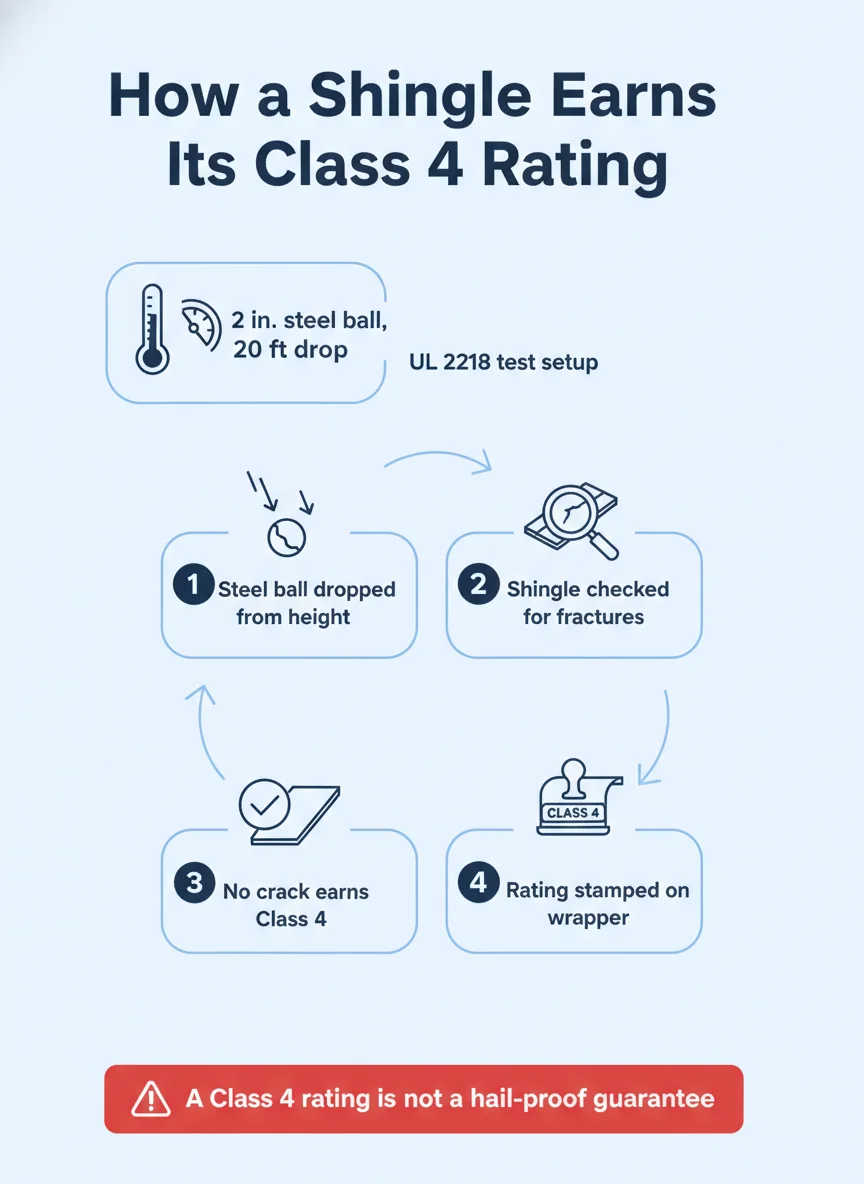
In the test, a steel ball of a specified size is dropped from a measured height onto a shingle sample, simulating the force of a hailstone impact. After each drop, the sample is examined closely, usually from the underside, for cracks, tears, or fractures in the mat beneath the surface granules. A shingle passes a given class level only if it shows no sign of cracking after the test is repeated at the required points on the sample.
The test doesn't simulate wind-driven hail, repeated impacts in the same spot, or impacts at odd angles, since it's designed to be a repeatable, controlled measure rather than a real-world storm simulation. That's an important distinction: the rating tells you how a shingle performed under one specific, standardized condition, not how it will perform in every storm it ever sees.
What Class 1 Through Class 4 Mean in Practice
UL 2218 assigns products a rating from Class 1 to Class 4 based on the size of steel ball they resist without cracking, with Class 4 being the highest and most impact-resistant tier. Most standard architectural shingles sold today aren't rated at all, or fall into the lower classes, while Class 4 products are usually built and marketed specifically around that top rating.
In practice, this means a Class 4 shingle has a reinforced construction designed to flex and absorb impact rather than crack on contact. That reinforcement is the whole reason the product costs more to manufacture, and it's also the reason the rating is treated as a meaningful selling point rather than just a label.
| Feature | Standard Architectural Shingle | Class 4 Impact-Resistant Shingle |
|---|---|---|
| UL 2218 rating | Often unrated or Class 1-2 | Class 4, the top tier |
| Mat construction | Standard fiberglass mat | Reinforced mat or polymer-modified layer |
| Typical use case | General residential roofing | Hail-prone regions, insurance-driven upgrades |
| Relative cost | Baseline | Higher upfront material cost |
What's Different Inside a Class 4 Shingle
From the street, a Class 4 shingle often looks nearly identical to a standard architectural shingle, same shadow lines, same granule colors, same basic shape. The difference lives underneath the surface granules, in the mat and the adhesive layers that give the shingle its structure. Manufacturers typically use a reinforced fiberglass mat or add a polymer-modified layer that lets the shingle flex slightly on impact instead of fracturing.
That flexibility is the whole mechanism behind the rating. A standard shingle under impact tends to crack along its mat, which can lead to granule loss and, eventually, a path for water to get underneath the surface. A Class 4 shingle is engineered to absorb that same energy without a structural crack forming, which is why it passes the steel-ball test at a higher threshold.
Step-by-step: How to Tell If Your Roof Already Has Class 4 Shingles
If you bought your home with the roof already on it, or you've lost track of the original paperwork, there are a few practical ways to figure out what's actually up there before you assume you need to upgrade.
- Check your closing documents: Look through your home purchase paperwork or any roofing invoice for a product name, which often indicates whether it's a Class 4 line.
- Look for leftover wrapper: If any shingle bundles were left in the attic or garage after installation, the wrapper usually lists the UL 2218 class rating directly.
- Search the product name online: Once you have a manufacturer and product line name, a quick search of the product spec sheet will confirm the rating.
- Ask a roofer to identify it: A roofer can often recognize a Class 4 product by its profile and stamp pattern even without paperwork on hand.
- Check your insurance file: If you've ever applied for an impact-resistant discount, your insurer's file may already have the rating documented from that application.
- Confirm before you pay for an upgrade: Don't assume you need Class 4 shingles until you've ruled out that your current roof already has them.
What Class 4 Shingles Resist and What They Don't
What the Rating Covers
A Class 4 shingle is built to resist cracking and mat fracture from a direct impact roughly comparable to the steel ball used in the UL 2218 test. In real-world terms, that generally translates to better resistance against moderate hail impacts that would crack or bruise a standard shingle, reducing the chance of granule loss and exposed mat after a storm.
That resistance is the main reason the rating matters to insurers and homeowners in storm-prone regions. A roof that holds up without visible impact damage after a hail event is less likely to need a full replacement, which is the practical benefit behind the upgrade.
What It Doesn't Protect Against
A Class 4 rating doesn't mean a shingle is immune to damage. Large hailstones, wind-driven impacts at a sharp angle, or repeated strikes in the same spot over multiple storms can still cause cosmetic bruising or, in severe cases, functional damage, even on a rated product. If you want background on what wind and hail damage can actually look like on a roof, our post on hail or wind damage after a storm covers that in more detail.
The rating also says nothing about how the shingle will age under UV exposure, how it handles wind uplift, or how it performs decades into its service life. Impact resistance is one property among several that determine how a roof holds up over time, not a substitute for proper installation, ventilation, and routine upkeep.
DIY vs Calling a Pro: Who Checks the Rating
Confirming whether your current roof has a Class 4 product is something most homeowners can do themselves with a bit of digging through paperwork or an online search, as outlined in the steps above. That part doesn't require a ladder or any roofing knowledge, just access to the right documents or a product name.
Where a licensed pro becomes useful is in physically identifying the shingle from its profile when no paperwork exists, and in assessing whether an existing roof has suffered impact damage that paperwork alone can't reveal. A trained eye can spot bruising, mat fracture, or granule loss from the ground or during a closer walk-through that an untrained homeowner might miss entirely.
Deciding whether to upgrade to Class 4 during a future shingle roofing project is also a conversation worth having with a roofer rather than deciding from a product brochure alone, since local weather patterns and your specific roof's exposure matter more than a generic recommendation.
Are Class 4 Shingles Worth the Upgrade in Missouri?
Whether the upgrade is worth it depends on your situation more than on the rating itself. Homeowners who've had repeated hail damage, who plan to stay in the home long term, or whose insurer offers a meaningful discount for impact-resistant roofing tend to see the clearest value. Homeowners planning to sell soon, or whose current roof is still well within its expected service life, may find the extra cost harder to justify.
The most useful next step is getting the facts specific to your roof and your policy rather than relying on a general rule of thumb, since the rating only tells part of the story. Full Life Roofing Construction can walk through what's currently on your roof and what a Class 4 upgrade would actually change for your home.
Frequently asked questions
What does a Class 4 shingle rating actually mean?
It means the shingle passed a standardized impact test, UL 2218, without cracking when struck by a steel ball dropped from a set height. It's a lab measure of impact resistance, not a promise that the shingle will never show damage on a real roof.
Are Class 4 shingles hail-proof?
No, they're hail-resistant, not hail-proof. Large enough hail or a direct hit at the wrong angle can still bruise or crack even a Class 4 shingle, it's just far less likely than with a standard shingle.
How can I tell if my roof already has Class 4 shingles?
Check the shingle wrapper, the original invoice, or the manufacturer's product line name, since Class 4 products are usually sold as a distinct line from standard architectural shingles. If you don't have paperwork, a roofer can often identify the product from the shingle's profile and stamp.
Do Class 4 shingles lower homeowners insurance premiums?
Some insurers offer a discount for impact-resistant roofing, but the amount and eligibility vary by carrier and policy. Check with your insurance company directly to see what, if anything, they offer in your area.
Do Class 4 shingles cost more than standard shingles?
Generally yes, since the reinforced mat and impact-rated design add material cost. Whether the upgrade pencils out depends on your insurer's discount, how long you plan to stay in the home, and your local weather history.